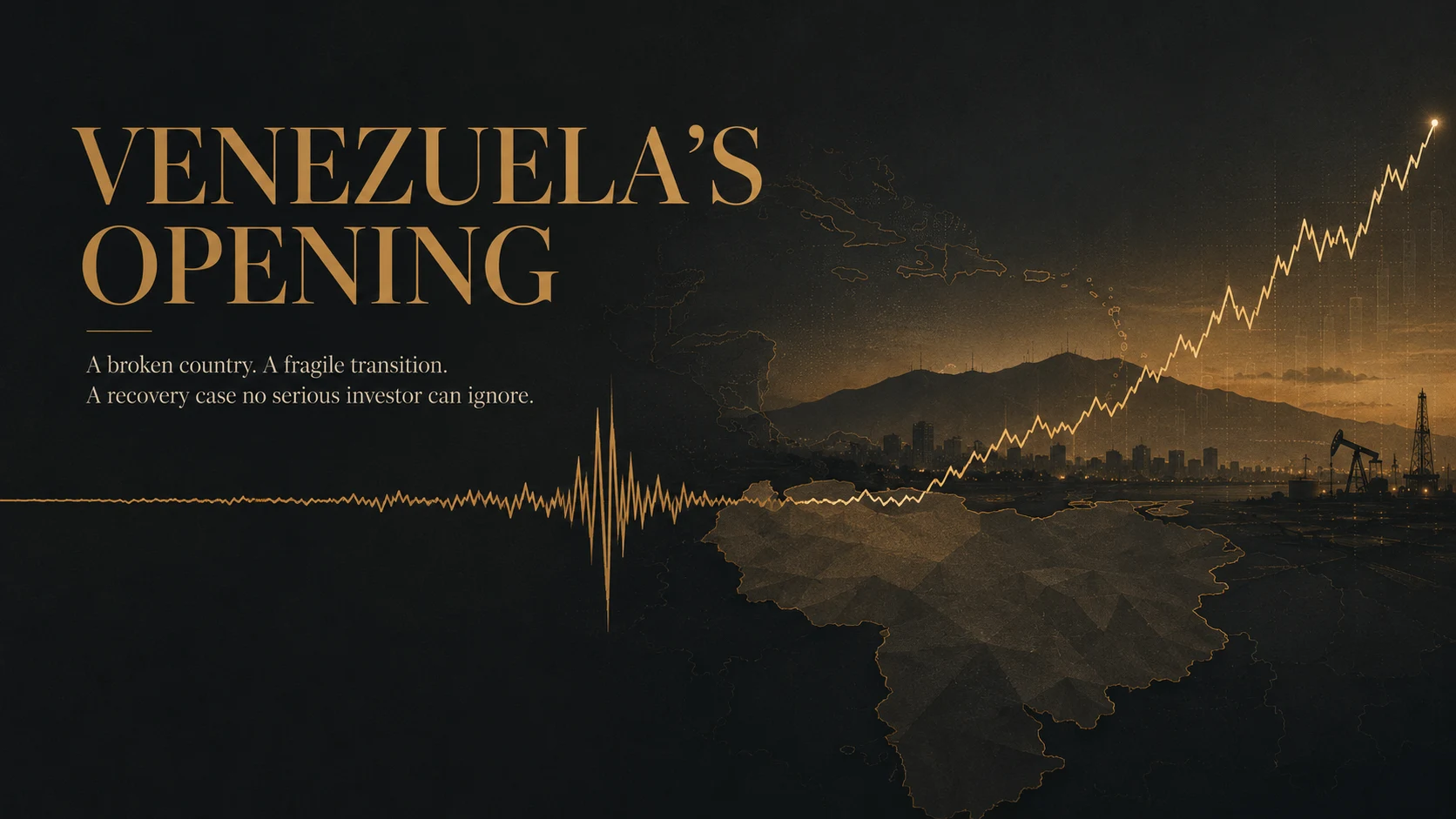
A broken country and a fragile transition — and the kind of bottom that, for patient risk capital, rarely announces itself this clearly.
Before anything else: our hearts go out to everyone in Venezuela who lost someone on June 24. What follows is written from cautious optimism about that country’s future, not opportunism about its grief. The case for looking at Venezuela now is, at heart, a bet that the place finally gets to recover. We hope it does.
There is a specific kind of opportunity that only appears when a country is on its knees, and it is almost always mistaken for either a sure thing or a graveyard. Venezuela in mid-2026 is neither. It is something rarer: a genuine bottom, with an address.
Start with what most people have forgotten: that Venezuela was rich. Not “developing-world comfortable.” Rich. By 1970 it was the wealthiest country in Latin America and one of the twenty wealthiest on earth, ahead of Greece, Israel, and Spain; at its oil-boom peak it ranked, by one World Economic Forum measure, fourth in the world in GDP per capita, alongside France. A founding member of OPEC, it sat on the largest proven oil reserves on the planet. The phrase people used, only half-joking, was “Saudi Venezuela.”
Then it chose a different operating system. After oil prices slumped in the late 1980s and unrest followed, a paratrooper named Hugo Chávez tried a coup in 1992, lost, and won the presidency at the ballot box in 1998. What came next is the most dramatic economic collapse of any country in modern history without a war. Chávez fired thousands of PDVSA’s most experienced engineers after a 2002–03 strike, gutting the technical core of the national oil company, and siphoned its revenue into “Bolivarian missions.” And he imported a partner: Cuba. In exchange for tens of thousands of Cuban doctors, Chávez shipped Havana billions of dollars of oil and, less visibly, let Cuban intelligence and security advisers entrench themselves inside the Venezuelan state, a relationship that outlasted him. GDP peaked at $372 billion in 2012 and then fell roughly 78% from that high. Some seven to eight million people left.
That is the hole. Here is why it suddenly matters.
The strongman is gone, but the seat isn’t empty in the way you think
On January 3, 2026, a US military operation captured Nicolás Maduro and his wife and removed them from the country; Maduro now faces drug-trafficking charges in a US federal court. This is the single biggest variable change in Venezuela in a generation, and it is worth being precise about what it did and did not do.
It did not install a friendly, pro-market government. The chavista Supreme Tribunal swore in Maduro’s former vice-president, Delcy Rodríguez, as acting president; she has publicly maintained that Maduro remains the “legitimate” leader. The figure the United States recognizes (opposition president-elect Edmundo González, whose 2024 victory Washington endorsed, backed by Nobel Peace laureate María Corina Machado) has not assumed power. What exists instead is a standoff: a chavista in the chair, a US-recognized winner in the wings, US-backed talks underway in Caracas as of June 2026, and a US president saying Washington will “run” Venezuela until a “safe” transition can be made.
The direction is unmistakably toward a market-friendly, US-aligned Venezuela, and the arrival is not guaranteed. That gap is the discount.
Two things are already moving in the right direction. A January 29 law handed private operators control over oil production and sale, and Washington has begun lifting oil-specific sanctions and issuing trading licenses: Venezuelan oil sales have already cleared $1 billion, with several billion more expected. The catch matters: the broad sanctions architecture is still largely in place, and investing legally means investing inside that framework. This is a “talk to sanctions counsel first” country, not a “wire money to a guy in Margarita” country.
Then the ground moved
On June 24, 2026, two strike-slip earthquakes (magnitude 7.2, followed 39 seconds later by a 7.5) struck near Morón on the central Caribbean coast, about 100 miles west of Caracas. The damage fell hardest on La Guaira and Caracas; at least 1,700 people were killed, more than 5,000 injured, and tens of thousands reported missing, with the toll still rising. (Margarita Island, contrary to early assumption, felt the 7.5 but was not the disaster zone: the catastrophe was mainland.) In its wake, Washington temporarily eased additional sanctions to allow relief to flow.
A tragedy is not an investment thesis, and it would be grotesque to pretend otherwise. But reconstruction is real, it is coming, and the honest question is whether capital that helps rebuild can also earn, without becoming what the Venezuelan press is already, pointedly, watching for.
Margarita, the “vultures,” and where the money actually goes
Here is where reading Venezuela in Spanish changes the picture. English-language coverage gives you Caracas, sanctions, and geopolitics. The Venezuelan press gives you the texture: on Isla Margarita, the property market is being described as an “island of prosperity” on the strength of foreign-investor inflows, with outlets noting that foreigners can now buy in on an investor visa. And in the same breath, the local conversation supplies its own conscience: Spanish-language commentary has warned of los buitres (the vultures) circling Isla Margarita, and Venezuelan social channels are circulating a blunt “llamado a cautela,” a call to caution. You do not get that counter-voice from a US real-estate blog. It is the most useful thing in the file, because it tells you exactly how to not be the story.
So, the practical shape of it, with the caveats load-bearing:
- This is an appreciation and lifestyle play, not a cash-flow play. Rental yield in a half-dollarized, capital-controlled economy is a headache. Give serious thought to Venezuela for what it could become (beachfront bought near the bottom, in a country reopening to the world), not for monthly rent. It is, and will remain, a genuinely spectacular vacation hub.
- Buy where Venezuelans with money already go. Margarita’s oceanfront, and the coastal enclaves the domestic wealthy never stopped favoring, are the liquid end of an illiquid market.
- Property rights are the real risk, and they have a track record. This is the country that nationalized and expropriated across the Chávez era. A right-leaning, US-aligned successor government would almost certainly strengthen property protections, but you are betting on that government arriving, not banking on today’s.
- Only risk capital. Full stop. Size the position as money you can lose entirely, because the range of outcomes is genuinely wide.
The Colombia rhyme, and the two-year question
The optimistic frame is not fantasy; it has a recent regional template. Twenty years ago, Colombia was a place you flew over. Today Medellín is a global expat and investment magnet, because security stabilized and the politics turned pragmatic and market-friendly. Venezuela could rhyme with that arc. It has better beaches, more oil, and a diaspora of seven-plus million people, many of whom would come home to a functioning country and bring capital with them.
But the rhyme depends entirely on the one thing nobody can yet schedule: the vote. As of mid-2026 there is no firm election date: Caracas has invoked emergency provisions to postpone, and US officials expect a presidential election only around 2027. That election is the hinge. If it delivers a González/Machado-style market-oriented government and the policy keeps leaning right, the reforms (oil relicensing, sanctions relief, property protections, an open door to capital) should compound, and today’s prices will look like the bottom they were. As long as the United States stays engaged, that direction is the path of least resistance. But a chavista still holds the acting presidency today, and “what happens in two years” is not rhetorical. It is the entire trade.
That is the honest shape of it. The country that forgot it was rich is being handed a second chance it did not choose and paid a terrible price to reach. For the patient investor (eyes open, counsel retained, risk capital only), the bottom of the barrel rarely announces itself this clearly. Give it serious thought. Just don’t mistake the discount for a guarantee, and don’t be a vulture.