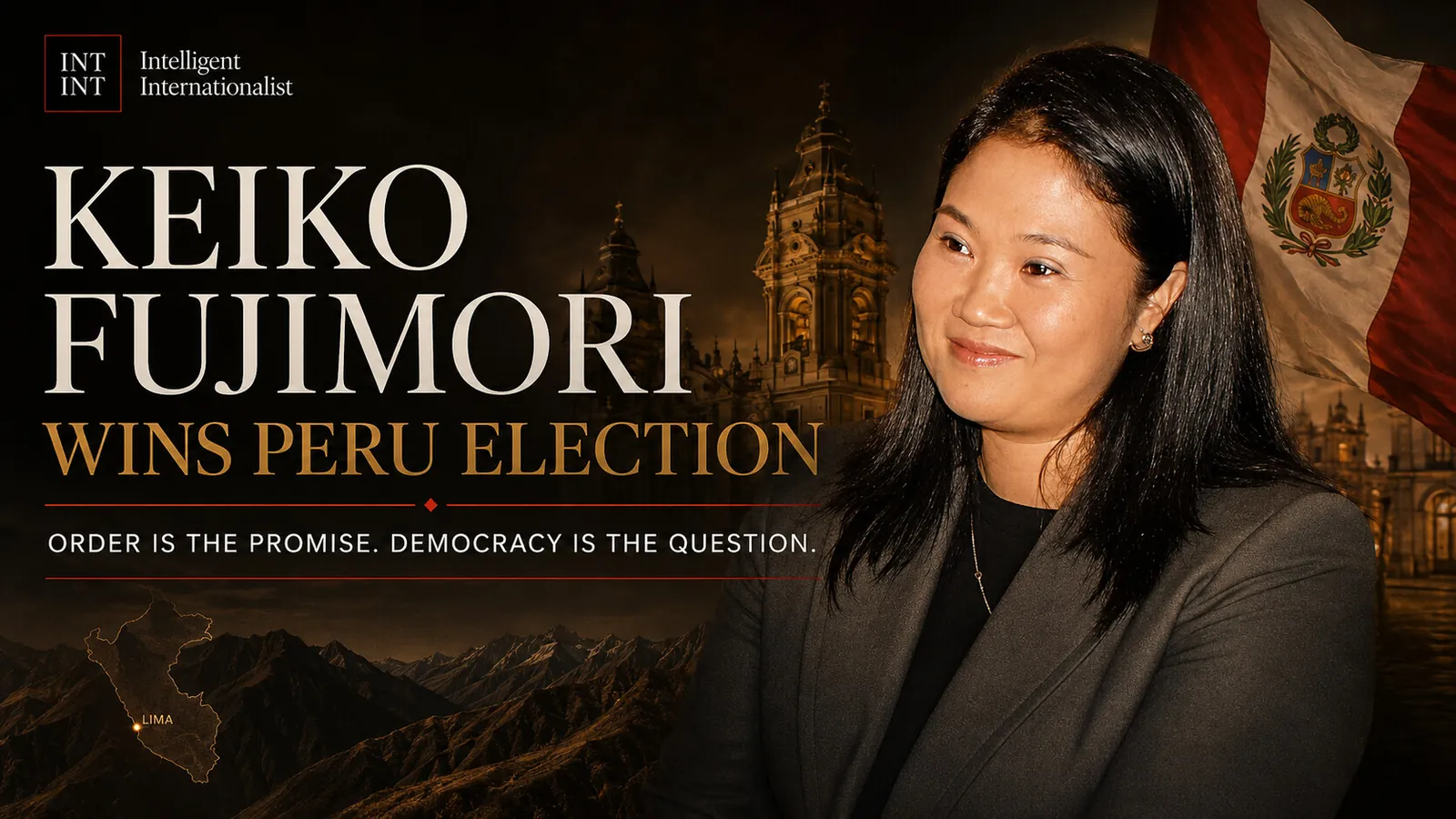
Keiko Fujimori won by the narrowest of margins, on a promise her father perfected thirty years ago: order. The crime crisis is real. So is the authoritarian temptation.
There is a number that captures Peru’s last decade better than any column of crime statistics: nine presidents in ten years. No president has completed a full term. The country has cycled through 21 prime ministers, 170 ministers, and 15 interior ministers in the last five years alone. A state that cannot keep a government cannot keep its streets safe. And Peru’s streets are not safe.
On June 7, 2026, Peruvians chose Keiko Fujimori by fewer than 50,000 votes, the third consecutive presidential election decided by less than a percentage point. Her opponent, leftist Roberto Sánchez, has cried fraud and refuses to concede. Her party, Fuerza Popular, holds the largest minority in both chambers of a newly restored bicameral Congress but no majority. Only 11% of the electorate voted for her in the first round. She takes office July 28 with no honeymoon, a divided mandate, and a question hovering over everything she does: whose playbook is she using? Her father’s, or her own?
The father’s shadow
To understand Keiko Fujimori, you have to understand Alberto Fujimori, and to understand Alberto Fujimori you have to hold two contradictory facts in your head at the same time without letting either cancel the other.
Fact one: he inherited a country in collapse. Hyperinflation was running at 7,000% annually; the Maoist Shining Path controlled roughly a third of the national territory. In 1992 he captured its leader, Abimael Guzmán. He ended the 1997 hostage crisis at the Japanese ambassador’s residence. He built schools, roads, and bridges in communities that had never seen a functioning state. The market reforms he forced through (drastic, unpopular, effective) created the framework that made Peru one of Latin America’s fastest-growing economies for two decades. The sol is now among the region’s most stable currencies; inflation, though it crept back to roughly 4% in mid-2026 amid a gas-supply shock, remains among the lowest on the continent.
Fact two: he dissolved Congress in 1992, suspended the constitution, and ruled as an autocrat. He directed a death squad, Grupo Colina, from an intelligence basement. He was convicted in 2009 of authorizing kidnappings and murders. His government forcibly sterilized hundreds of thousands of women, most of them poor and Indigenous. His spymaster, Vladimiro Montesinos, bribed lawmakers with cash and controlled much of the press. When the Montesinos tapes surfaced in 2000, Fujimori fled to Japan and resigned by fax. Congress rejected the resignation and declared him “morally unfit.”
The same man who crushed a terrorist insurgency also deployed terrorism as state policy. Both facts are true. That is not cognitive dissonance. That is Peru.
Alberto Fujimori died in September 2024, at 86, ten months after being pardoned. His state funeral drew mourners and protesters in roughly equal measure; the country held three days of national mourning for a convicted human-rights abuser. Keiko was 19 when he made her first lady. She spent her twenties, thirties, and forties running for president on his name: losing in 2011, 2016, and 2021, each time by a margin smaller than the last, and spending nearly eighteen months in pretrial detention on campaign-finance charges later dismissed. On her fourth try, she won. The “anti-Fujimori” vote that blocked her three times finally cracked, not because Peruvians stopped fearing authoritarianism, but because they started fearing the alternative more. The crime statistics made her argument for her.
The crime crisis
Here are the numbers that elected Keiko Fujimori. The homicide rate has nearly doubled in five years, from 5.8 per 100,000 in 2020 to 10.7 in 2025. Extortion cases reported to the Public Ministry hit 22,835 in 2024, a 379% increase from 2021. In the first eight months of 2025 alone, 180 bus and taxi drivers were murdered for refusing to pay extortion, killed because they dealt in cash. Roughly 100 extortion gangs operate in Lima alone, targeting florists, restaurants, small stores, and even schools in poor neighborhoods, demanding payments from teachers who earn minimum salaries.
At 10.7 per 100,000 the rate is not the region’s worst: Ecuador, Colombia, Mexico, and Brazil are all higher. What makes Peru different is the trajectory. A country that spent a decade with flat or declining violent crime has seen the line go vertical. The drivers are structural and opportunistic: Peru borders Colombia, the world’s largest cocaine producer, and Ecuador, a surging transshipment hub; illegal gold mining, logging, and land-grabbing offer diversified revenue to launder through corrupt officials; the 2025 dismantling of USAID removed a partial backstop. And the political chaos (seven heads of state in a decade, an interior ministry that turns over every four months) meant no one was steering. Nearly 60% of residents in San Juan de Lurigancho, Lima’s most populous district, report being extortion victims, and official statistics may capture as little as 20% of actual cases.
The campaign worked because it offered an explanation that felt true: democracy failed you. The system that replaced my father could not protect you. Only a strong hand can.
The mano dura problem
Keiko has said she wants to “govern like my father.” She has proposed reviving the system of “faceless judges” he used to prosecute terrorism in the 1990s (later condemned for denying due process), and her party has pushed amnesty for police and military involved in crimes during his government. The template is obvious: do what Alberto did to the Shining Path, but aim it at the extortion gangs. So is the appeal: the gangs are terrorizing ordinary people, and ordinary people want them gone. And so is the risk: mano dura without institutional constraints produces order of a kind that eventually turns on the population it is meant to protect.
The defining question, as Americas Quarterly put it, is what kind of order Fujimori wants: authoritarian or democratic. The answer determines not just Peru’s civil liberties but its economic trajectory. The $63 billion mining pipeline depends on legal certainty. The tourism sector, 3.26 million international visitors in 2024, up 30% on the year but still about a quarter below pre-pandemic levels (about 74% of the 2019 peak of 5.3 million), depends on the perception of safety, not just its reality. If her order involves police violence, suppressed protests, and a compliant judiciary, the investment-grade ratings Peru took decades to earn will not survive the backlash. There is a second question, equally important: revenge or reconciliation? After her narrow 2016 loss, her party spent five years sabotaging the winner. Now that her side controls the judiciary, the question is whether she uses it to settle scores or build institutions that outlast her. The early signals are mixed.
The geopolitical calculus
Peru sits at the intersection of two global competitions that have nothing to do with its internal politics: the energy transition and the U.S.–China rivalry. Both run through Peruvian soil. Peru is the world’s third-largest copper producer (behind Chile and the DRC), third in silver, second in zinc, and a top-ten gold producer; mining exports hit a projected $55 billion in 2025. Copper demand (driven by electrification, grid buildout, and AI data centers) is not plateauing. The 11 projects worth $8 billion planned for 2025–2026 are permitted, financed, and waiting on the one variable Peruvian politics has refused to provide for a decade: a government that can make a decision and enforce it.
Then there is the port. Chancay, 80 kilometers north of Lima, is China’s $3.5 billion deepwater mega-port, operational since late 2024, connecting Peruvian minerals directly to Shanghai. The United States has responded with offers to renovate the Peruvian Navy’s base and invest in competing port infrastructure. Fujimori inherits a chessboard where she holds pieces both powers want. Her stated line (cooperation and investment promotion with Washington, a pragmatic, non-zero-sum approach to Beijing) is the only plausible strategy for a country whose largest trading partner is China and whose most important security partner is the United States. Whether she can hold that balance through a polarized Congress and a population suspicious of both powers is another matter.
The traveler’s Peru
For the reader weighing a visit, a second home, or a longer stay: Peru in mid-2026 is a country of extraordinary draw and real friction. Lima’s gastronomy is arguably the best in the Americas: Central, Maido, Kjolle, and a dozen others justify a week in Miraflores on food alone. The Sacred Valley and Machu Picchu remain essential. The Maras salt mines, still worked by local families after 500 years, are a day trip from Cusco most tourists skip and shouldn’t. The northern beaches at Máncora and Punta Sal offer surf at a fraction of Caribbean prices; the Colca Canyon outside Arequipa is twice as deep as the Grand Canyon with a fraction of the crowds.
But Australia’s travel advisory captures the reality: “Exercise a high degree of caution. A state of emergency is in effect for Lima and Callao.” The extortion epidemic hits the businesses travelers depend on: taxis, small restaurants, tour operators. The safe districts (Miraflores, San Isidro, Barranco) remain safe, but the boundary between the safe Lima and the unsafe Lima is thinner than it used to be, and the unsafe Lima is growing. The bet on Peru as a destination is a bet on Fujimori’s security promise: reduce visible street crime in the tourist corridors (not eliminate it, just reduce it to where the average visitor doesn’t encounter it) and the growth curve continues. Fail, or provoke destabilizing backlash, and the bet gets harder.
The bottom line
Peru’s election of Keiko Fujimori is not a verdict on her father. It is a verdict on the decade of chaos that followed his departure. Peruvians did not vote for authoritarianism; they voted against disorder. They know what Alberto Fujimori did. They also know what happened after he left: nine presidents in ten years, homicide rates doubling, extortion gangs taking over schools, a state that could not keep a cabinet together long enough to write a security policy. They chose the strong hand because the weak hand had failed them so completely that the risk seemed acceptable by comparison.
Whether it proves acceptable depends on what she does with a narrow, fragile mandate. The economic opportunity is real: $63 billion in mining, a tourism sector accelerating, a geostrategic position both superpowers want. The authoritarian temptation is real: her father’s playbook is sitting right there, and it worked, until it didn’t. The crime crisis is real: homicide at 10.7 and climbing, extortion at epidemic scale, a population that has lost faith in the state’s ability to protect it.
Can a Fujimori deliver order without sacrificing the democracy her father dismantled? The first one couldn’t. The second has spent thirty years building a machine designed to win. Now she has to prove she can govern.
The Peruvian writer Santiago Roncagliolo, noting that Alberto Fujimori and Abimael Guzmán died on the same date (September 11) three years apart and at the same age, offered a hope that serves as well as any closing line: let it be an omen for an era with neither terrorists nor dictators; let the universe be saying Peru can be a democracy. The universe doesn’t decide. The new president does.