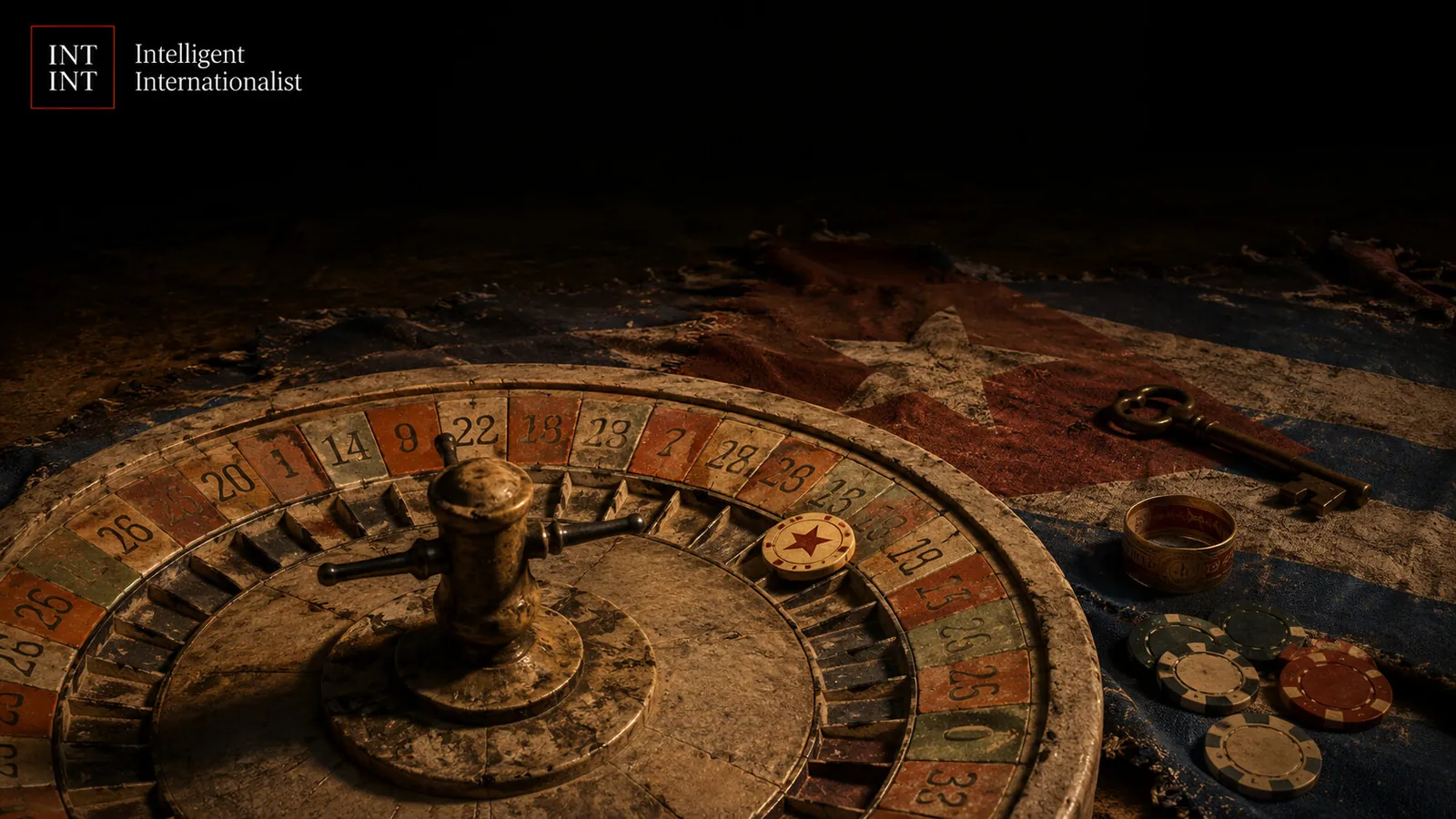
The prediction markets have priced it. Raúl Castro is 95 and Fidel a decade dead. The U.S. Navy is in the Caribbean. The question is no longer whether Cuba falls — it’s who collects when it does.
On January 3, 2026, U.S. Delta Force operators extracted Nicolás Maduro from Caracas in Operation Absolute Resolve. Thirty-two Cuban intelligence escorts were killed. Within 24 hours, the Polymarket odds of Miguel Díaz-Canel leaving power spiked sharply.
The market corrected. It always does. But the spike told you something real: the rules had changed. The United States was no longer treating regime change in the Western Hemisphere as a thought experiment. It was treating it as an operation.
| Market | Odds | Volume |
|---|---|---|
| Cuban regime falls in 2026 | 15% | $1.4M |
| Díaz-Canel out by Dec 31 | 60% | $2.7M+ |
| U.S. invades Cuba in 2026 | 17% | – |
| U.S.–Cuba military clash in 2026 | 44% | – |
| Raúl Castro in U.S. custody by Jun 30 | 6% | – |
The regime-fall market opened March 10 at 28% and has drifted downward. The leadership-change market opened in the low teens and has climbed steadily. The spread between the two is the story. Traders think Díaz-Canel goes. They do not think the Communist Party goes with him.
A leadership change without a regime change. A new face without a new system. The market is pricing a managed transition: the kind Marco Rubio’s team discussed with Raúl Castro’s grandson in a hotel in Saint Kitts during the CARICOM summit. The kind Raúl himself seemed to endorse on June 18 when, at 95, he approved economic reforms by videoconference, declaring that transforming the economy “is what best serves the Revolution today.”
The bets are in. Now let’s talk about what they’re actually betting on.
The paradise that was
Before Fidel Castro descended from the Sierra Maestra in January 1959, Havana was the casino capital of the Western Hemisphere. Not Las Vegas. Havana. In 1957, Cuba had more televisions per capita than any Latin American country and ranked among the top five in the world. The Riviera, the Capri, the Nacional, the Tropicana: these were Meyer Lansky operations, backed by the Genovese and Trafficante families, moving money through Cuban banks that asked no questions. The mafia did not control Havana. It rented Havana, and the rent was paid to Fulgencio Batista, the dictator Castro overthrew.
Havana in the 1950s was what Dubai in the 2000s would try to manufacture, and it had it organically. The Mob Museum in Las Vegas has an entire exhibit on the fact that the rise of the Vegas Strip was directly enabled by the fall of Havana: when Castro closed the casinos in 1959, the mob needed a new jurisdiction with friendly regulators and warm weather. They found Nevada. The rest is the Bellagio.
Cuba was supposed to be the Switzerland of the Caribbean, not a metaphor but a literal ambition. Geographic position, financial sophistication, a dollarized parallel economy that handled North American and European capital effortlessly. The real estate, particularly in Havana, was architecturally irreplaceable: Spanish colonial, art deco, mid-century modern, layered on a city that had been building for 500 years. Varadero’s beaches were already legendary. The ports were natural. The proximity to the United States was absurd: 90 miles from Key West. And then, in 24 months, it was all gone. The casinos became barracks, the hotels government offices, the banks nationalized, the property seized. The families that built the place (including the family of a boy named Marco Antonio Rubio, born in Miami to Cuban immigrants who had left everything behind) became exiles.
The Rubio factor
Marco Rubio is the first Secretary of State in American history for whom Cuba policy is not foreign policy. It is family history. His parents arrived in the U.S. in 1956 with two toddlers and never received a penny from the U.S. government. He grew up in the exile community of West Miami and Hialeah, where old men played dominoes and talked about the day they would go back. As a boy, Rubio wrote that he “boasted I would someday lead an army of exiles to overthrow Fidel Castro and become president of a free Cuba.”
He is now simultaneously Secretary of State and acting national security adviser, the first to hold both roles since Henry Kissinger. The Cuban-American machinery of Miami-Dade has been one of the most reliable Republican blocs in the country for two generations. Trump does not need to care about Cuba philosophically; he needs to care electorally, and he does. The pressure campaign Rubio has assembled is the most aggressive since the Bay of Pigs: a fuel blockade, oil-tanker interdiction, a CIA in-person ultimatum in Havana, a Justice Department indictment of Raúl Castro, the USS Nimitz strike group in the Caribbean, sanctions on Díaz-Canel and the Castro family network; and, in the background, the quiet channel: the meeting in Saint Kitts, the message traffic between Washington and Raúl Castro’s family about what comes after.
CNN reported on June 7 that Trump has shown ambivalence: “I don’t know about changing the regime.” The markets heard it: regime-fall odds drifted from 28% to 15%. Trump wants a deal he can call a victory. Rubio wants a free Cuba. The tension between those two objectives is the central variable in every prediction market on the island.
This is the golden ring for Marco Rubio. This is what he has dreamed about, both personally and professionally.
Former U.S. diplomat, Havana
What the markets are pricing
The 15% on full regime collapse is the sober number. It accounts for the historical base rate (Cuba has had two regime changes in 80 years) and for the repressive apparatus, the intelligence network, the cohesion of the military elite, the absence of an organized opposition, the billions stashed abroad by regime figures with every incentive to keep the system intact, and China’s stake in Cuban stability. It accounts for the fact that Díaz-Canel is not the regime; he is an employee of it, and the Castro family still holds the equity through Raúl.
But the 60% on Díaz-Canel’s departure is the action number, pricing a different scenario entirely: a managed succession in which the figurehead changes and the structure survives. Raúl Castro’s grandson meets with Rubio’s team. Raúl endorses reforms. Díaz-Canel takes the fall for the economic collapse: the blackouts, the 20-plus-hour outages, 12.5% inflation, food lines, medicine shortages. A new face. Same party. This has happened before: when Maduro was extracted, Delcy Rodríguez stepped in and the Venezuelan regime did not collapse. The markets are pricing the Cuban version of the same play. And the 17% on a U.S. invasion is historically astonishing: in any year since 1962 it would have been effectively zero. That is not a prediction of invasion; it is a measurement of how far the Overton window has shifted under an administration that has already extracted a sitting head of state in the hemisphere.
What comes after
Díaz-Canel is replaced by a Raúl-approved successor. Reforms expand private investment; Cubans abroad repatriate capital on the same terms as foreigners. The Party stays the sole legal party, the military keeps the commanding heights, the U.S. lifts some sanctions. Not freedom: survival with a new face.
The oil blockade pushes the economy past the point of no return. Blackouts pass 48 hours. The military fractures, contained protests turn uncontainable, the Party loses de facto control, and a transitional authority forms. Priced as a tail risk, but with $1.4M behind it, serious money is paying attention.
A Venezuela-style operation. Raúl Castro is neutralized, a provisional government installed, elections scheduled. And 2.4 million Cuban Americans, with capital, expertise, and 60 years of motivation, flood back. Remarkably, higher odds than full internal collapse.
In any scenario, the question of annexation hovers. It is not viable on the American side: no one in Congress is introducing a Cuba statehood bill. But the sentiment on the island is different from what American commentators imagine. Cubans have watched Miami get built. They know exactly what Cuban entrepreneurship and American capital produce when combined: the transformation of a sleepy Florida beach town into a global capital in two generations. The Cubans who built Miami did it as refugees with nothing. Imagine what they could do with title deeds, contract enforcement, and U.S. banking. Varadero is undeveloped by Caribbean standards. Old Havana’s 500 years of architecture is intact under the decay. The ports are natural deepwater; the soil grows premium tobacco and sugarcane. A post-communist Cuba aligned with the U.S., with property rights and investment protections, would attract capital at a velocity that would make the Dominican Republic’s tourism boom look slow.
The resilience question
The counterargument to every prediction market on Cuba is the same: they have survived worse. The collapse of the Soviet Union, which erased 35% of Cuba’s GDP overnight. The Special Period of the 1990s, when the average Cuban adult lost 20 pounds. Sixty years of U.S. sanctions. A hundred CIA assassination attempts on the late Fidel. The Obama opening and its reversal. COVID. The Venezuela collapse. All of it survived.
But they have never faced this combination at once: a U.S. administration willing to use military force for regime change; a neighbor state, Venezuela, whose oil lifeline has been severed; a Cuban-American Secretary of State for whom this is the mission of a lifetime; and a generational hinge that cannot be transferred. Fidel has been dead since 2016. Raúl Castro is 95. And his personal hold on the system, the last living thread of the 1959 revolution, cannot be handed to a successor the way a title deed can. Layer on an economic crisis that Prime Minister Manuel Marrero himself calls “practically a wartime economy” (20-plus-hour blackouts, 12.5% inflation, shortages of food, fuel, water, and medicine), and the math changes.
The regime is resilient. But resilience is not immortality. Every dictatorship eventually meets a set of conditions it cannot survive.
The bottom line
The bets are in. They are not betting on a revolution. They are not betting on democracy. They are betting on a transition: managed, messy, incomplete, but real. The 60% on Díaz-Canel’s departure is the market’s way of saying the status quo has already failed. The 15% on full collapse is its way of saying the after is still unknowable. What happens next depends on three people: Marco Rubio, who has wanted this his entire life; Donald Trump, who wants a deal he can call a victory; and Raúl Castro, who holds the phone when the next ultimatum arrives.
Cuba was supposed to be the Switzerland of the Caribbean. It became a prison. The bars are bending. The markets are asking whether they will break.