
The manufacturing exodus from China is real, structural, and accelerating. No country has caught more of it than Vietnam.
The numbers make a seductive case. Vietnam’s GDP grew 8.0% in 2025, the fastest pace in ASEAN. Foreign direct investment disbursements hit an all-time high of $27.6 billion, up 9% from the prior year’s record. Exports crossed $405 billion in 2024, with electronics alone accounting for nearly a third. The median age is 33; literacy is 96%; manufacturing wages run roughly a third to a half of China’s coastal provinces. If you designed a country for the “China Plus One” migration in a spreadsheet, Vietnam is what you’d get.
On the ground, the migration isn’t theoretical. Samsung now produces more than half its global smartphones in Vietnam. Apple’s supplier network has followed: by 2025, roughly 20% of iPads and Apple Watches and two-thirds of certain accessories were assembled in-country. Vietnam has overtaken China as the largest apparel supplier to the United States. This is a structural growth story, not a commodity cycle. The question for an investor is not whether Vietnam is growing (it is) but what kind of return that growth delivers to external capital, and what everyone else has already priced in.
The ceiling is lower than it looks
Vietnam’s growth has been so rapid that its infrastructure is visibly straining. Northern Vietnam, where most electronics FDI concentrates, endured rolling power outages through 2023 and 2024 that shut down entire industrial parks. A 2024 energy outlook concluded bluntly that the local grid and urban planning “are currently not prepared” for the industrial economy Vietnam is trying to become. Transmission takes years to build; the country has also retroactively cut contracted revenues on 173 solar and wind projects by 25–46%, chilling exactly the private energy investment needed to close the gap.
Then there is the political layer. The “Blazing Furnace” anti-corruption campaign has removed a former president, two deputy prime ministers, and hundreds of officials. It is popular, but it has a documented chilling effect: an estimated $2.5 billion in foreign aid went unclaimed between 2022 and 2024 because officials became unwilling to sign anything that might later be scrutinized. The campaign has not yet produced a visibly cleaner state, but it has produced a visibly slower one.
Record FDI tells you about multinational supply-chain decisions. It does not automatically predict broad-based domestic prosperity.
The trade-deficit problem
The United States is watching, and the numbers are escalating. The U.S. trade deficit with Vietnam reached $111.6 billion in the first eleven months of 2024 (an 18% jump year-over-year), making Vietnam the fourth-largest bilateral surplus with the U.S., behind only China, the EU, and Mexico. This is the kind of trajectory that attracts tariff scrutiny in any administration, and the current one has moved: Vietnam’s exports now face tariffs of up to 20% on broad categories. The dong trades near all-time lows (~26,295 to the dollar) and remains on the Treasury’s monitoring list. Export-reliant economies with concentrated exposure to the U.S. consumer don’t get to negotiate from strength.
The Mexico parallel
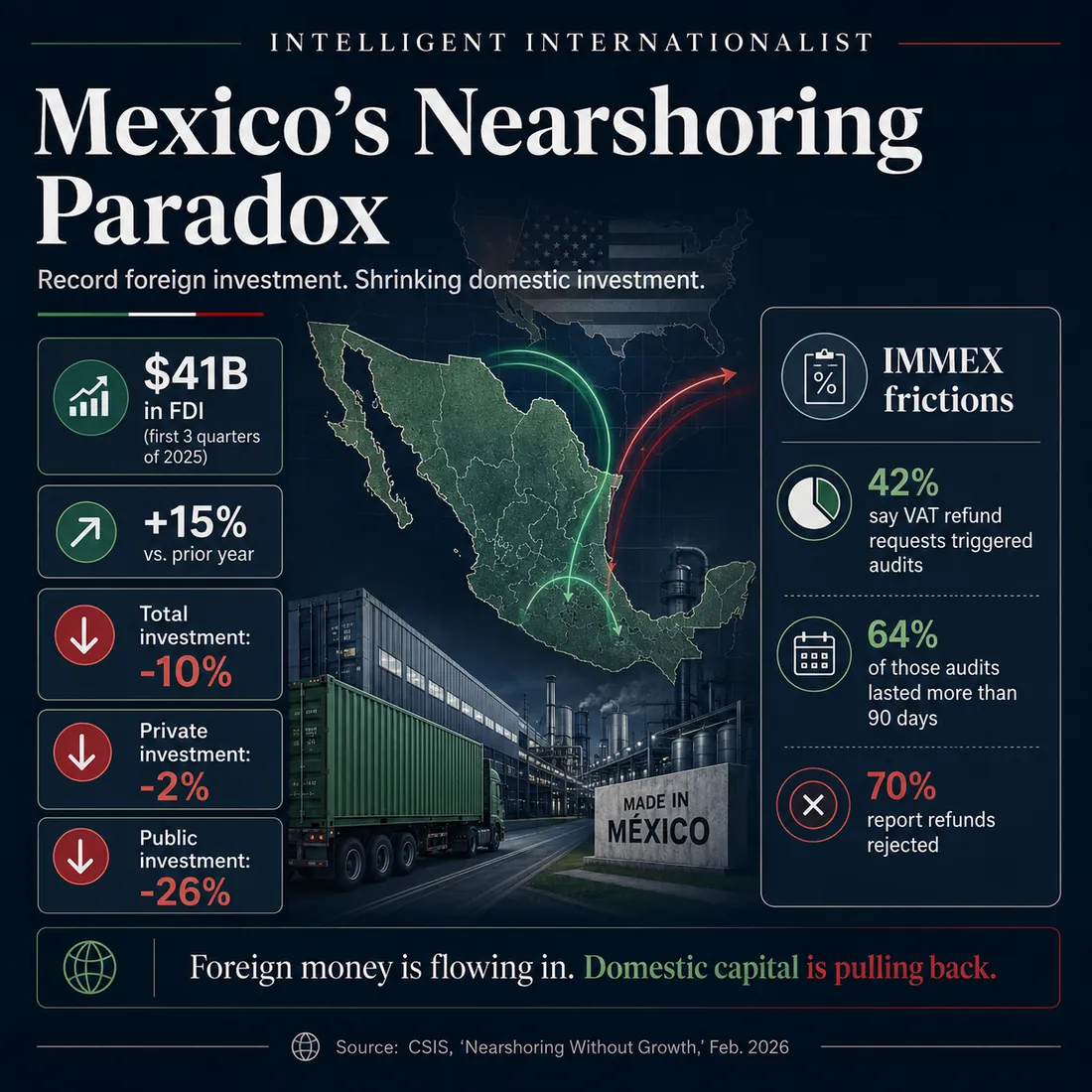
This is the thread that separates the Vietnam bull case from the Vietnam investment case, because it has a recent, well-documented precedent. Mexico attracted the same breathless coverage: record FDI of $40.9 billion in the first three quarters of 2025, a nearshoring boom, global manufacturers in industrial parks. But look at what FDI delivered. It concentrated overwhelmingly in northern border states; it did not diffuse. Average manufacturing wages settled around $4.90/hour. Ninety-one percent of industrial systems experienced power failures, and over 60% of the grid now runs near full capacity. Transmission expanded 0.10% in 2023 while demand grew 3.5%.
The lesson is not that FDI is harmful. It is that FDI is a narrow metric. FDI firms (mostly Korean, Chinese, Japanese, Taiwanese) account for 98% of Vietnam’s $126.5 billion in electronics exports. Domestic firms operate at just 64% of the technological frontier set by these foreign players, and that gap has not narrowed in a decade.
You can set FDI records for a decade and still have an infrastructure deficit, stagnant real wages, and a domestic sector locked out of the value chain.
This is the governance discount. Vietnam is attracting the factories. It has not yet demonstrated it can turn them into a broad-based, domestically-owned, innovation-driven economy. The FTSE upgrade to Secondary Emerging Market status (confirmed for September 2026) and the MSCI roadmap for 2030 suggest a policy trajectory in the right direction. But the gap between “attracting FDI” and “building an investable domestic economy” is where returns get compressed.
The property bubble no one is watching
While manufacturing FDI dominates headlines, Vietnam has been quietly inflating one of the world’s least affordable property markets. Hanoi apartment prices rose 33% year-over-year in Q2 2025; Ho Chi Minh City condos averaged $4,691 per square meter, a 47% annual increase. By Numbeo’s mid-2025 index, Vietnam ranks fifth of 103 countries for housing unaffordability: an average Hanoian would need more than 20 years of income, with zero expenses, to afford a mid-sized apartment. The driver is loose credit: real-estate loans reached 23.7% of total bank lending. The pro-growth stance enabling 8%-plus GDP targets is the same stance inflating the sector, and the state is structurally disincentivized from bursting it while it chases the growth targets the Party set at its 14th National Congress. Understand what kind of growth you are buying: credit-fueled, policy-directed, with embedded financial-stability risk.
Exposure without entanglement
For the U.S. investor, the menu is narrow by design. Direct ownership of Vietnamese equities is practically impossible for foreign individuals: foreign-ownership limits, custody restrictions, pre-funding rules. Foreigners cannot own land. The primary vehicle is the VanEck Vietnam ETF (VNM), the largest and most liquid U.S.-listed single-country fund, trading around a 15 P/E. The FTSE upgrade in September 2026 should trigger an estimated $6 billion in passive inflows; the MSCI upgrade targeted for 2030 would be the larger catalyst. Both are catalysts, not theses in themselves. As a lifestyle base, Vietnam is excellent (cost of living runs ~60% below U.S. levels), but the friction (visa runs, bureaucratic opacity, Hanoi air quality, the one-party reality) makes it a second-home play, not an investment thesis.
The bottom line
Vietnam is a growth story with a governance discount. The migration is real, the demographics are a tailwind, and the market-classification upgrades will pull in passive capital. But the ceiling is set by infrastructure that cannot keep up, a political system that trades decisiveness for control, a trade surplus large enough to invite punitive policy, and a domestic economy stubbornly disconnected from the FDI boom everyone is celebrating. The Mexico parallel is instructive because it is so clean. Vietnam is earlier in that arc (it has more room to run), but the pattern is recognizable.
It is the most investable frontier-to-emerging name in Southeast Asia. But it is a satellite position, a secondary opportunity in a portfolio whose core stays where capital protection is not up for negotiation.