Nearshoring Without Growth
Foreign money is pouring in at record levels. Domestic capital is pulling back. The factories are going up. The jobs are not.
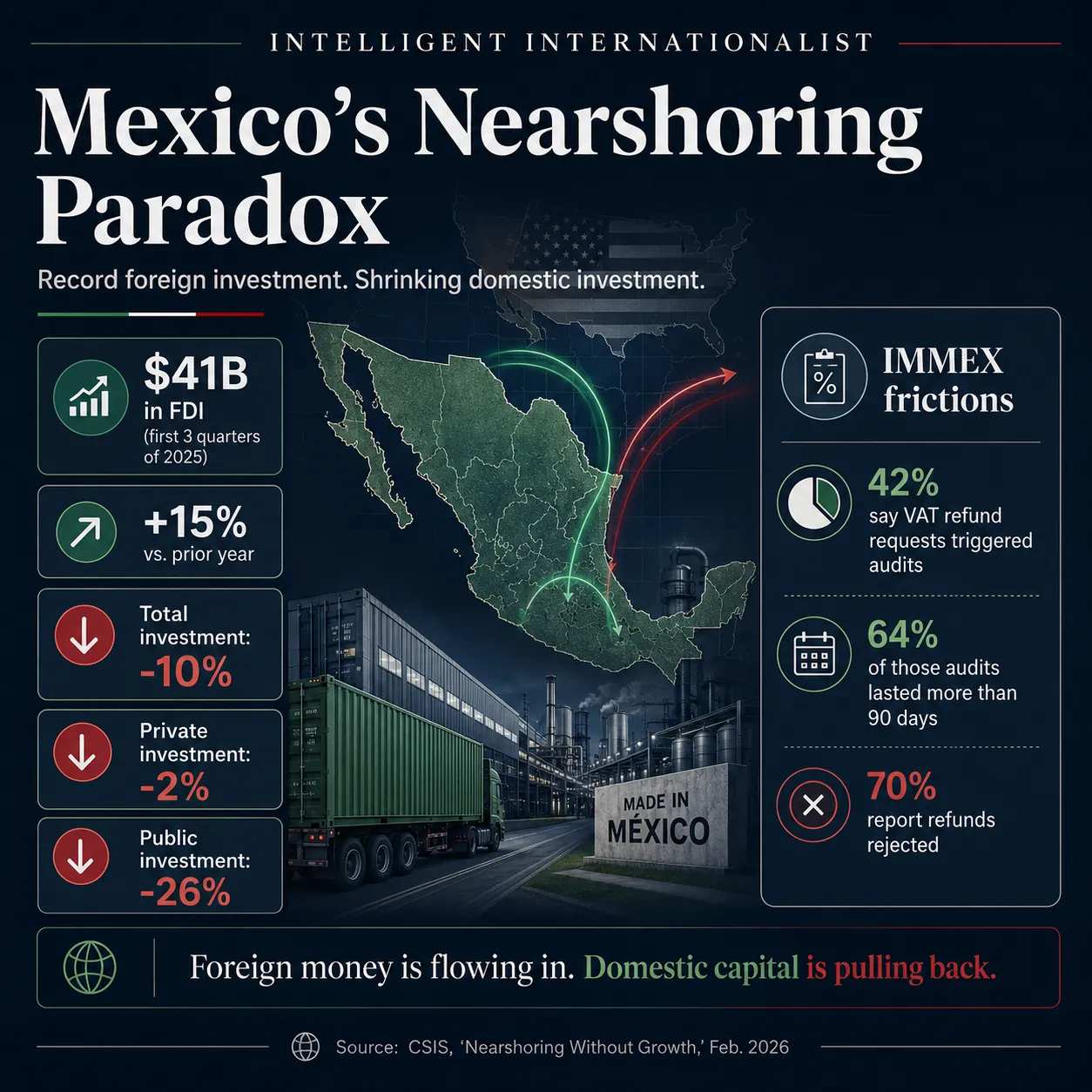
Mexico absorbed roughly $41 billion in foreign direct investment in the first three quarters of 2025, a 15% year-on-year increase, a new record, and more than the full-year total of any prior year. Greenfield investment tripled to $6.56 billion, signaling new plant construction rather than portfolio reallocation. In January 2026 alone, the country announced or inaugurated $5.8 billion in new projects across energy, industrial parks, automotive, pharmaceuticals, and advanced manufacturing. Kearney’s 2026 FDI Confidence Index moved Mexico from 25th to 19th, one of the largest single-year jumps in the ranking’s history.
USMCA compliance among Mexican exporters surged from roughly 45% to 89% in a single year. Goods that meet the rules of origin enter the United States at an effective tariff near zero; Chinese goods, by comparison, face significantly higher average U.S. effective tariffs, often 20–30%+ depending on the category. A container ships from Mexico to the U.S. for roughly $2,700 and crosses in two days. A container from China costs more than $4,000 and takes 36 days by sea. Average Mexican manufacturing wages run $4.90 an hour versus $6.50 in China.
Everything in the nearshoring thesis is working. Except the growth. Except the jobs. Except the investment confidence that sustains both.
The split screen
Hold two numbers side by side and let neither cancel the other. Record FDI, $41 billion. And total domestic investment fell approximately 10% in 2025. Private investment declined roughly 2%; public investment dropped more than 26%. The gross fixed investment-to-GDP ratio slipped from 24.8% to 22%, moving away from the 25% target set by President Claudia Sheinbaum’s Plan México, the most comprehensive industrial policy the country has ever attempted.
Manufacturing employment fell by 127,200 jobs in the same period, the worst annual result since 2008. Payrolls have now contracted for 35 consecutive months. GDP grew 0.6% in 2025, its weakest since the pandemic; 2026 forecasts cluster at 1.5%–1.8%. That is not a nearshoring boom. That is a nearshoring paradox. The standard narrative (that supply chains fleeing China will naturally land in Mexico, bringing jobs and industrialization) is correct in direction and wrong in mechanism. The money is arriving. But it arrives in forms that do not behave the way the narrative predicted.
Why investment and jobs uncoupled
The new FDI flows into capital-intensive, highly automated facilities. BMW’s $800 million lithium-ion battery center in San Luis Potosí will transform the region’s industrial base and employ a fraction of the workers a traditional assembly plant would require. Foxconn’s $900 million AI-server plant near Guadalajara is strategically vital and employs far fewer people than the maquila lines of the 1990s. This is not a failure of nearshoring; it is nearshoring working as the global economy actually operates in 2026: advanced manufacturing, automation, robotics. The investment numbers are large. The payroll numbers are small. The link between FDI and broad-based employment that defined Mexican industrialization for two generations has broken.
Meanwhile, the same forces that make Mexico attractive are driving up costs where production concentrates. Industrial rents in northern Mexico surged 39% in a single year. Per-square-meter prices in Monterrey’s prime zones now approach premium Miami districts. Water and electricity constraints in the northern industrial belt are increasingly cited as binding operational risks, and AI-driven data-center demand is compounding the strain on the grid. Specialized technical talent is being bid up in a competition that erodes the very wage advantage that drew investment in the first place. The result: a boom visible in the FDI column, faint in employment, and negative in domestic investment. Three numbers, one story.
The IMMEX problem
The IMMEX program (Industria Manufacturera, Maquiladora y de Servicios de Exportación) is the cornerstone of Mexican export manufacturing. It covers roughly 15% of the formal manufacturing workforce, allows duty-free, VAT-deferred import of components for re-export, and was instrumental in turning a $14 billion trade deficit in 2006 into a $771 million surplus in 2025. By any measure, one of the most successful industrial-policy tools in the hemisphere. And it is being slowly dismantled by its own tax authority.
VAT refunds under IMMEX: the audit trap.
The tax authority, SAT, threatens to suspend importing licenses unless disputed amounts are paid: even during ongoing audits, even when the amounts are under active dispute, even when the interpretation being applied did not exist when the transactions occurred. Retroactive reinterpretations of VAT rules sometimes reach back nearly a decade: firms that received approved refunds in 2017 are now told they owe the money back, plus fines, plus interest. The KPMG finding that roughly 70% of final tax-dispute judgments favor the authority over private firms does not make this environment more predictable. It makes it more dangerous.
When fiscal obligations intersect with discretionary enforcement, the risk premium on investment rises, directly offsetting Mexico’s many inherent advantages.
CSIS, “Nearshoring Without Growth”
The mechanism is not complicated. A manufacturer under IMMEX needs to know that today’s rules will be applied clearly and consistently tomorrow. When the authority can reach back a decade and reclassify compliant transactions as violations, the rational response is not to invest more: it is to hold cash. Capital that could fund expansion is immobilized as a reserve against enforcement risk, and IMMEX shifts from an investment incentive to a source of contingent liability. Firms keep operating; they postpone the new long-term, capital-intensive projects. That decision, repeated across hundreds of firms and billions of dollars, is the gap between the FDI record and the domestic-investment decline. The foreign money arrives because the structural advantages are undeniable. The domestic money stays parked because the rules are unpredictable.
The security tax
Large, fragmented swaths of Mexican territory operate under some degree of cartel influence. Cargo theft along logistics corridors is a persistent, hidden operating cost. The killing of CJNG leader “El Mencho” may trigger fragmentation and retaliatory violence in the run-up to the 2026 World Cup, which Mexico is co-hosting. Microsoft now ranks Mexico second globally in cyber risk, tying that exposure to its nearshoring-linked manufacturing base and underdeveloped cybergovernance; across Latin America, 75% of companies rate the cyber incidents of the past two years as serious. No fiscal incentive offsets a factory that cannot reliably receive inputs or ship outputs. No tax break compensates for a supply-chain manager who is being extorted. These are not marginal costs; they are baked into the investment calculus, and they are rising.
The USMCA review: July 2026
The entire nearshoring thesis rests on a single assumption: that USMCA-compliant goods keep entering the United States tariff-free. That assumption is now being tested: the first formal joint review of the agreement began July 1, 2026. The Trump administration has signaled a genuine renegotiation: tighter rules of origin to squeeze out Chinese content, higher U.S.-content thresholds in automobiles, stronger labor enforcement.
Best case: preserves the existing framework. Keeps the peso near 17–18 per dollar.
Most likely: extension with forced concessions on content and labor.
Tail risk: descent into annual reviews. Could push the peso past 20. Highest cost.
Every battery plant, every AI-server line, every signed industrial lease in Mexico was underwritten on the assumption of continued tariff-free access to the U.S. market. Weaken that assumption and the entire investment case requires reexamination.
The bottom line
Mexico’s nearshoring advantage is real, the strongest in the post-NAFTA era. The geography is not changing. The wage gap, narrowing at the high-skill margin, still holds at the manufacturing floor. The USMCA architecture, whatever happens in July, will not be dismantled entirely. The secular shift of supply chains out of China is not reversing, and Mexico is the clearest structural beneficiary. But structural advantages without institutional credibility produce weak outcomes. The IMMEX tax uncertainty is not a tax problem: it is a rule-of-law problem. The cartel presence is not a security problem: it is a governance problem. The uncoupling of investment and employment is not a statistical artifact: it is an industrialization problem.
Foreign money builds the factories. Domestic money builds the country. Right now, only one of those is happening.
The July USMCA review is a forcing function. It will either concentrate Mexico’s attention on the institutional reforms investor confidence requires, or it will expose how much of the nearshoring thesis was built on geography alone. Geography is a gift. Governance is a choice.