
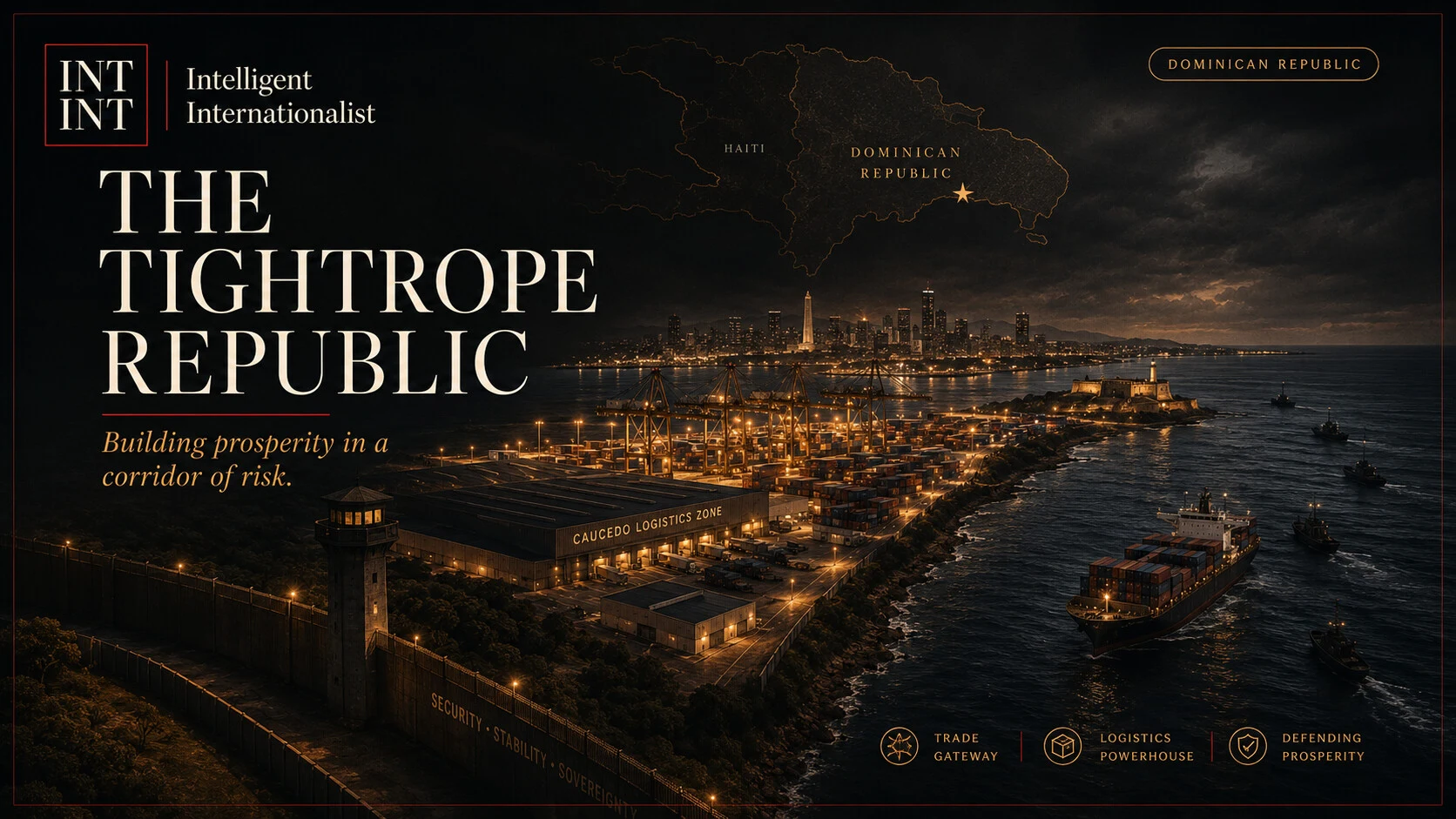
Record foreign investment and a narco-transit problem, on the same island. A narrow, focused bet that the numbers say is working.
The Dominican Republic is having a moment. The kind of moment that makes you check the numbers twice because they don’t look real.
$5.03 billion in foreign direct investment last year. Fourth consecutive record. Nearly double what it was pulling five years ago. Q1 2026 added another $1.54 billion, up 6.4% year over year. GDP growth projections for 2026 range from the IMF’s 3.7% to local forecasts as high as 4.8%, depending on who you ask and what assumptions they are using. Inflation is a boring 3.7%. Nine of the top 30 medical device companies on the planet, including Medtronic and Johnson & Johnson, now manufacture there. Over 800 companies operate across roughly 92 free trade zones. DP World dropped $760 million on a port expansion and logistics hub that nobody in the Caribbean has attempted at this scale.
This is not tourism money. This is not “let’s build another all-inclusive and hope the flights fill up.” This is supply chain money. Manufacturing money. The kind of capital that stays.
And yet.
If you pull on any thread in the Dominican Republic’s economic story, you eventually hit cocaine.
The US State Department estimates roughly 6% of US-bound cocaine transits through the Dominican Republic. That number may sound small. It is not. Nearly 20 tons were seized in 2025 alone. Colombian and Venezuelan trafficking organizations use the DR as a transit node: speedboats to the south coast, containers through the ports, private aircraft where enforcement is thinner. The routes adapt. They always adapt. When Trump’s border policies squeezed the overland corridors, the Caribbean sea routes lit up. The cartels didn’t retire. They changed the shipping address. The broader Caribbean corridor remains a major trafficking artery (at its peak, US and UN agencies estimated a majority of US-bound cocaine moved through it), and the DR sits squarely in the middle.
This is the dual identity of America’s most interesting nearshoring partner. The question is not whether both exist. The question is whether the first can outgrow the second before the second defines how the world sees the first.
One country, two economies: medical devices by day, mule routes by night.
The Puerto Rico lesson
The Puerto Rico comparison is instructive, and not in the way Puerto Rico would prefer.
Puerto Rico had every structural advantage. US territory. No federal tariffs on mainland trade. No currency risk. An English-capable workforce. Federal courts. FDIC-insured banks. For decades, Section 936 tax incentives made it the default manufacturing platform for American pharma and medical devices.
It still lost.
The DR doesn’t have any of those advantages, and it is winning. Not on everything (Puerto Rico’s pharmaceutical complex is not going anywhere), but on the segments where cost, flexibility, and policy agility matter more than legal status. The DR offers CAFTA-DR preferential access to the US market without the Jones Act shipping costs that make Puerto Rican logistics a tax on every container. It offers free trade zones with real tax holidays, not the expired 936 framework and its uncertain congressional renewals. It offers a sovereign government that can negotiate directly with Washington, unmediated by a territorial status that nobody in Congress wants to resolve.
And it offers something Puerto Rico structurally cannot: the ability to set its own incentives, control its own labor costs, and pitch itself as a partner rather than a dependency.
Puerto Rico knows this. It recently ran a trade mission to Santo Domingo. When the territory with every advantage sends a delegation to the country that outcompeted it, the market has spoken.
Abinader understands the assignment
President Luis Abinader is not flashy. He is a businessman who became a politician, not the other way around. Second term. Speaks the language of investment. In November 2025, he stood next to New York Governor Kathy Hochul and signed a declaration of intent to deepen trade, tourism, and economic ties between the DR and the Empire State. A New York trade mission to the DR is on the calendar. He has personally pitched American textile and footwear executives at industry summits. When DP World needed a government that would not get in the way of a $760 million bet on the Port of Caucedo, Abinader’s administration delivered.
On the security side, the signals are equally clear. The DR granted the US access to a military air base and restricted airport areas for counter-narcotics logistics in late 2025. The DEA’s Caribbean Division and the Dominican drug enforcement agency run joint operations. A US Navy airstrike in September 2025 destroyed a vessel carrying over a ton of cocaine in Dominican waters. The Caribbean Basin Security Initiative has channeled hundreds of millions of dollars into regional interdiction capacity over the past decade and a half.
This is not window dressing. These are concrete, measurable steps. Both capitals understand that the manufacturing story and the security story are the same story. You cannot have one without progress on the other.
Then there is Haiti
The DR is building a border wall along its 391-kilometer border with Haiti. Not a fence: a concrete barrier with sensors and patrols. As of early 2026, roughly 164 kilometers are planned, with about 54 kilometers completed and an additional 13 kilometers approved for acceleration. The government has made very clear it will deport 10,000 people a week if it has to. Haiti’s collapse is not theoretical. 1.4 million displaced. Gang violence concentrated in Port-au-Prince. A state that functionally does not exist.
The spillover risk is real, and the DR is handling it. Not perfectly. Not without controversy. But with a clarity of action that investors notice.
Here is what matters: having a collapsed state on your border is a drag, not an edge. It doesn’t create opportunity. It creates a problem that must be managed. The DR is managing it. The wall, the deportations, the layered enforcement: these are not opportunistic moves. They are the price of admission for a country that wants to be taken seriously as an investment destination while sharing an island with chaos.
Even if Haiti were healthy tomorrow, the DR would still be the play. The CAFTA-DR advantages don’t depend on Haiti’s dysfunction. The free trade zones don’t need a contrast case to look good. The manufacturing cluster, the port infrastructure, the Abinader government’s alignment with US commercial interests: none of that requires Haiti to fail. It stands on its own.
Haiti is not the reason the DR is winning. It is the loudest test of whether the DR can protect what it is building. So far, it is passing.
What this means for American capital
The DR is not China. It is not Vietnam. It is not even Mexico. It is a mid-sized Caribbean economy with a focused bet on specific sectors (medical devices, textiles, logistics), leveraging trade architecture that already exists and a government that wants to deepen it.
The data says the bet is working. FDI has nearly doubled in five years. Reinvestment rates exceed 60%. Companies that enter the free trade zones tend to stay and expand. The medical device cluster, in particular, has crossed the threshold where it feeds itself: suppliers follow manufacturers, talent pools deepen, the ecosystem becomes sticky. DP World’s Caucedo expansion is infrastructure built for the next decade, not the last one.
The narco transit variable is the obvious ceiling. It is also the variable both governments are visibly working on. Seizures are material. Interdiction capacity is improving. The air-base access agreement is not a press release. It is operational. The question is whether enforcement progress keeps pace with cartel adaptation. That is an empirical question, not a narrative one. Watch the seizure data. Watch the cooperation agreements. If both trend upward, the ceiling rises. If either plateaus, the ceiling is lower than the FDI numbers suggest.
Corruption exists. It exists in the DR’s enforcement institutions just as it exists across the region. The difference between the DR and, say, Venezuela is not the absence of corruption. It is the presence of a government that appears to understand that corruption is a cost on its own investment proposition. Abinader hasn’t fully solved it (his administration has made progress on anti-corruption enforcement, but the problem is deep-rooted), and nobody expected him to. He has signaled that solving it is in his own economic interest. In emerging markets, that alignment is about as good as it gets.
The bottom line
The Dominican Republic is executing a narrow, focused bet: leverage proximity to the United States, a favorable trade agreement, and improving security alignment to capture manufacturing and logistics activity that would otherwise stay in Asia or migrate to higher-cost US territories. The numbers show it is working. The security cooperation shows both capitals understand the parallel track that must keep pace. The Haiti situation, for all its tragedy, reinforces the relative stability argument: not because the DR benefits from Haiti’s chaos, but because the DR’s ability to protect its borders and manage the spillover is itself a signal to capital.
Is it a sure thing? No. Nothing at the intersection of emerging-market manufacturing, Caribbean narcotics transit, and great-power supply-chain competition is a sure thing. But the trend lines are unusually clear. FDI records. GDP growth. Active US partnership. A government that appears to want the right things, even if it cannot deliver all of them at once.
For American businesses and capital allocators evaluating regional options, the DR is not the only data point. But right now, it is one of the clearer ones.