Corruption is a price, not a character flaw — and Singapore is the one country that decided to outbid it.
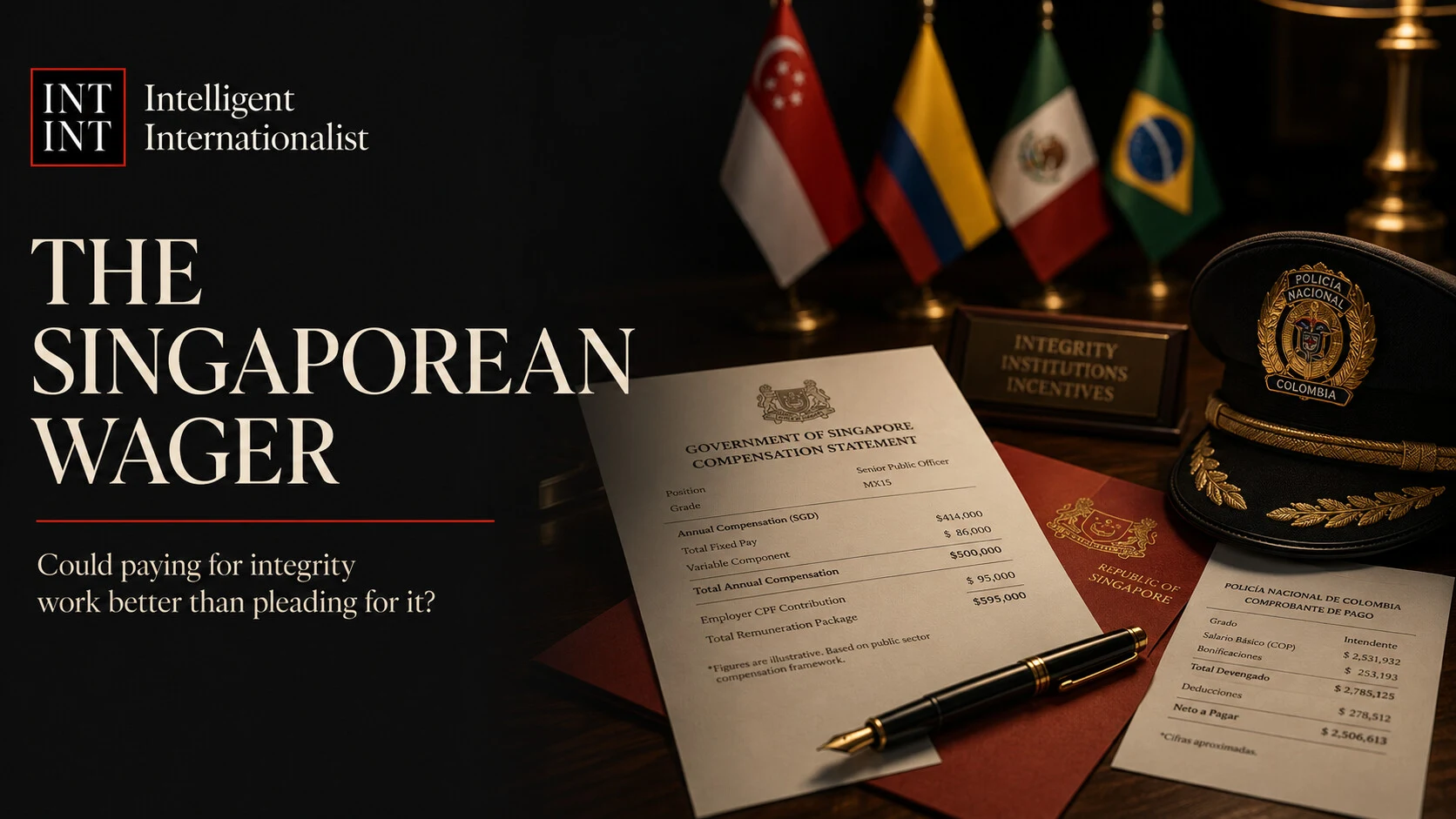
There is a number worth sitting with: somewhere between $600 and $900 a month. That is the range a rank-and-file Colombian patrol officer earns: a base of roughly COP 2.4 to 3.1 million, with risk and family allowances lifting the all-in total toward $900, depending on rank and posting. In the same neighborhoods that officer patrols, a trafficking organization can offer several times a month’s salary for thirty seconds of deliberate blindness.
This is not a sermon about morality. It is an observation about price signals and rational choice, and it is not only Colombia’s problem. The same arithmetic governs Brazil and Mexico, the other two countries at the top of every expat’s shortlist. When the personal cost of refusing a bribe exceeds the personal benefit of refusing it, most people, eventually, do the math. Moral exhortation has its place. It has never been a reliable substitute for incentives that align with how human beings actually behave under pressure.
Singapore placed a different kind of wager decades ago. It decided the most effective way to make corruption rare was not to beg people to be virtuous, but to make corruption economically irrational for the individuals who hold discretionary power. The gap is visible in the data. Singapore scores 84 on Transparency International’s Corruption Perceptions Index and ranks third in the world. Colombia scores 37; Brazil, 35; Mexico, 27: a fraction of Singapore’s figure, and the three destinations most Americans and Europeans are quietly eyeing.
The three pillars, and the one nobody likes to name
Singapore’s approach has three elements. Two are discussed constantly. The third makes people uncomfortable, because it collides with romantic ideas about public service.
The first is enforcement. The Corrupt Practices Investigation Bureau operates with genuine independence under the Prime Minister’s Office. It can investigate any person, any account, any transaction; the legal definition of corruption is deliberately wide. Capability plus a credible threat of consequences compounds, over years, into deterrence.
The second is political will at the top. Lee Kuan Yew made clean government a foundational state project, and when senior figures were investigated, the consequences were total. The precedent was set, and it held.
The third is compensation. Singapore’s Prime Minister earns on the order of S$2.2 million a year. Ministers are benchmarked against top private-sector earners, discounted for the ethos of public service, but still substantial. Police and civil servants at every level are paid to compete with the private sector, with real career progression. Public service in Singapore is prestigious partly because it is well paid.
The argument, made openly since the 1990s, is that a person who already holds substantial legitimate income, prestige, and a pension has far more to lose from corruption than to gain. A bribe large enough to matter is large enough to trigger serious risk of detection and forfeiture. The math tilts toward honesty not because people are saints, but because the structure makes corruption the expensive choice. It is the same logic that makes us pay pilots, surgeons, and chief executives enough that losing the position is unaffordable. We rarely apply it to the people who hold the state’s monopoly on force, or who sign off on contracts worth millions.
The Latin-American calculation, reframed
Return to the officer earning $600 to $900 a month in a place where a single blind eye can be worth several times that. This is not, in any meaningful sense, a test of character. It is a market. The bribe improves the officer’s circumstances; the probability of real detection is low; the expected value of accepting is positive, and the expected value of refusing, in narrow financial terms, is often negative.
Scale that upward. A procurement official or permit approver in Bogotá, São Paulo, or Mexico City handles sums that dwarf a lifetime of official salary. A modest “arrangement” can represent years of security. Refusing preserves an abstract integrity while locking in permanent precarity for the family; accepting changes the family’s trajectory. In that environment, honesty is the luxury good.
Corruption, framed this way, is not primarily a cultural defect or a failure of civic education. It is a predictable response to mispriced incentives: the state underpricing integrity relative to the temptations it tolerates.
That framing travels. Colombia at 37, Brazil at 35, Mexico at 27 are not three separate moral failures. They are three versions of the same equation, solved the way the incentives point.
What the thought experiment suggests
Take Singapore’s wager seriously as a thought experiment (not a sacred model to copy) and a few things follow for any country where low public pay coexists with high-stakes discretion.
First, the senior level matters most, for signalling and for reducing top-down capture. When the people who set the tone and control the largest flows already enjoy real security and esteem, the bribe required to move them rises sharply, and enforcement gets a clearer target.
Second, the logic cascades. If senior roles are compensated so that corruption is irrational, it becomes easier to push the same pressure down into the police and the military, the institutions facing direct, organized temptation from armed groups. An officer who can send his children to good schools and carries real social respect is solving a different equation than one for whom a cartel payment is the difference between precarity and comfort.
Third, enforcement and pay are complements, not substitutes. High pay without credible, independent investigation simply subsidizes a better class of corrupt official. Ruthless enforcement without adequate pay simply raises the risk premium corrupt actors demand. Singapore paired both.
None of this is cheap. But the recurring costs of the current equilibrium (withheld investment, inflated project costs, the security burden of low-trust institutions, and the emigration of the talented who see no future where connections beat merit) are expensive too, and they compound quietly.
A note on implementation
If a country explored this seriously, it would not be a matter of writing larger checks. It would require benchmarking public roles against private-sector equivalents, careful design of the performance components, and investigative bodies with real independence and protection from political interference, technical work as much as political. Governments attempting comparable reforms have generally drawn on specialized advisory capacity: people who have studied compensation architecture, civil-service professionalization, and how to build enforcement agencies that constrain power rather than merely announce that they do. That expertise exists; it can be imported, adapted, or grown at home. The point is not that Singapore’s exact arrangements transplant cleanly, but that the underlying wager deserves to be examined on its merits rather than dismissed because it feels impolite to discuss pay and integrity in the same sentence.
The bottom line
Corruption does not only move money. It erodes the credibility of the state’s rules, raises the cost of capital for everyone, and teaches the next generation that the highest returns come from navigating extraction rather than creating value. A society that systematically underprices honesty in its institutions is subsidizing its own long-term weakness.
Singapore made a cold calculation: clean government, built on incentives that respect human nature rather than lecture it, was cheaper over time than the alternative. The wager was never that people would become angels. It was that structures could be built in which angels and ordinary people alike would find the honest path to be the one that made sense for their families. Whether that wager is worth placing, in adapted form, in Colombia (or Brazil, or Mexico) is not a question slogans about culture can settle. It is a question about whether we are willing to treat corruption as the economic and institutional problem it largely is, and to pay the upfront price of making integrity the cheaper option for the people who matter most.
A speculative reflection on incentives, not a policy prescription or a claim about any current government. Corruption scores are Transparency International’s CPI 2025; Colombian pay figures are approximate, illustrative of the incentive gap rather than a precise current wage.