The NATO summit in Ankara was a pricing event — the alliance map is being redrawn, and alignment with American interests is a tradable asset.
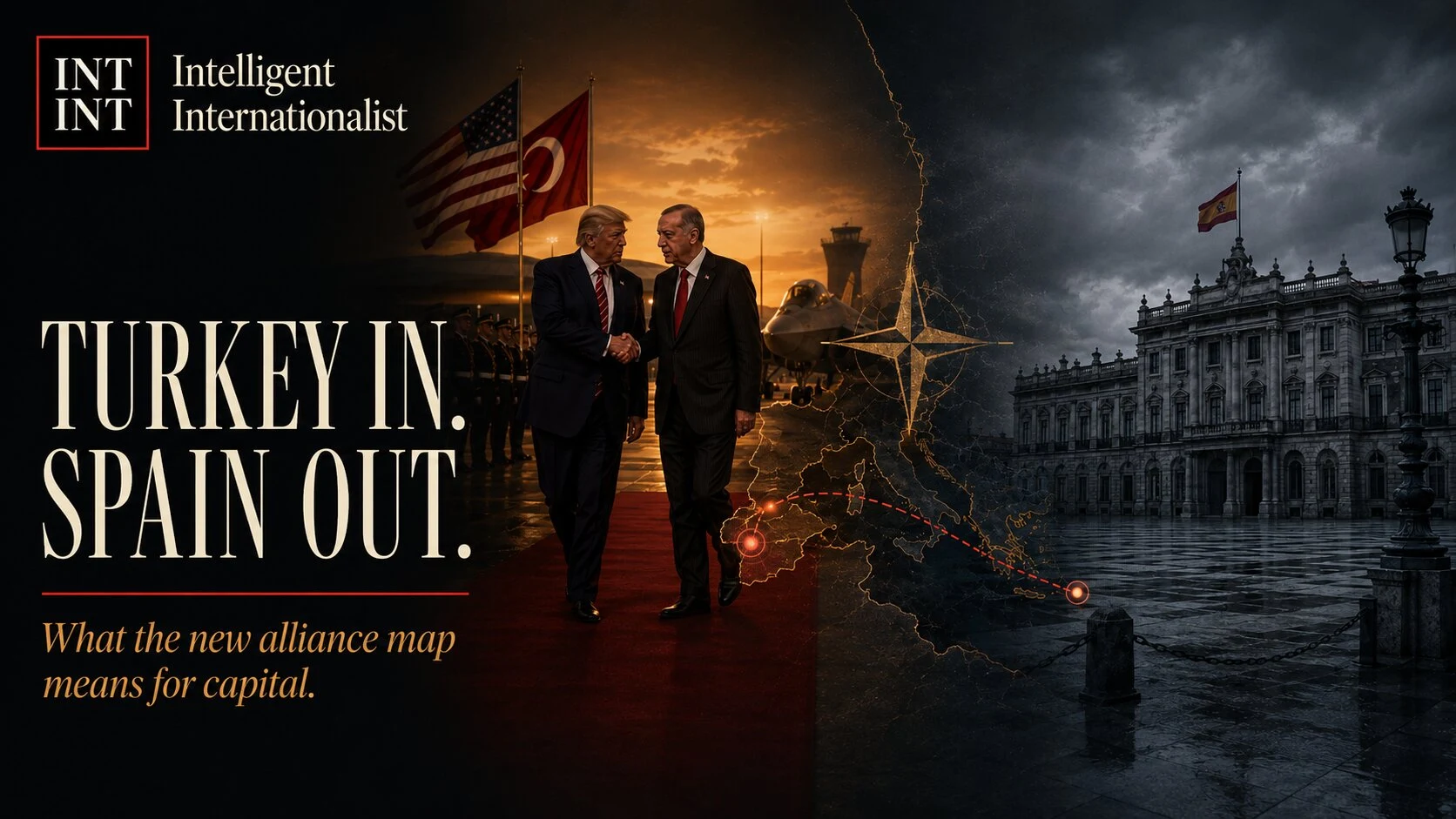
Donald Trump stood next to Recep Tayyip Erdogan in Ankara on July 7 and told the world exactly how the new alliance map works. To Turkey: F-35 fighter jets are back on the table, sanctions are being lifted, Erdogan is a “valuable friend.” To Spain, in the same press conference: “Cut off all trade with Spain, please, including visits. Don’t even talk to them. They’re hopeless, bad people.”
The contrast is not subtle. It is not accidental. It is the most legible signal Washington has sent about who is inside the tent and who is outside it, and it has direct implications for anyone allocating capital across geographies. This is not a policy paper. This is the new operating manual.
Spain: The Price of Sitting Out
Spain spent 2.1% of GDP on defense in 2025. It is the only NATO member that refused to commit to the alliance’s 5% target by 2035. It carved out a special exemption. While the rest of the alliance, however grudgingly, signed up for the hike, Madrid said no.
Then came the Iran war. Spain blocked US forces from accessing jointly operated military bases for offensive operations. It closed its airspace to American aircraft involved in the conflict. Prime Minister Pedro Sanchez emerged as one of Europe’s most vocal critics of American action, accusing Washington of dragging the world into a war that brought only “insecurity and pain.”
This is not a disagreement about trade policy or tariff rates. This is a fundamental refusal to participate in the security architecture that underwrites the trade relationship. And the American response, as of July 8, is equally fundamental: we are done.
“You got Spain to pay 2%,” NATO Secretary-General Mark Rutte interjected as Trump unloaded, attempting to soften the blow. “They made a huge step in the last year.” Trump was unmoved. The math is the math. Spain’s economy is roughly $1.5 trillion. Two percent is $30 billion. The 5% target would be $75 billion. The gap between what Spain commits and what Washington now demands is not marginal. It is structural.
And Spain is not alone in this category. It is merely the most explicit case. Across Western Europe, the same dynamics are playing out in slower motion. The European Green Deal has made energy a competitive liability, up to 30% of production costs for industrial firms. Carbon pricing compounds it. The result is not theoretical: firms are scaling back, relocating, or shutting down. Deindustrialization is accelerating. The EU’s own Clean Industrial Deal framework acknowledges the problem in language that reads like a confession. Immigration policy across the continent has been, to put it generously, uncontrolled. The bureaucracy that makes European life pleasant in certain dimensions, walkable cities, consumer protections, labor rights, makes it nearly impossible to move at speed in others.
Europe is not a monolith. But the direction of travel is clear. Washington is losing patience with partners who consume security without contributing to it, and the economic policies those partners have chosen are making them less competitive at the same time.
Turkey: The Counterexample
Turkey is not a perfect partner. Its democratic credentials are dubious. Its inflation story is genuinely alarming: 85% at peak, now down to roughly 32% and still rising again in recent months. The policy rate sits at 37%, the highest in the G20. The lira is under constant pressure. Corruption perception scores are below the global average. This is not a country you pitch to a pension fund.
But here is what Turkey is: a NATO member with the alliance’s second-largest military, a defense industry generating $15.1 billion in annual turnover across 3,500 companies, and a government that has demonstrated, repeatedly, at material cost, that it is willing to align with American strategic interests when the terms are clear.
Trump’s Ankara visit produced concrete deliverables. F-35 restoration. Sanctions relief. Erdogan called him a “valuable friend” in bilateral meetings. This is not the language of a tense relationship being managed. It is the language of a deal being struck.
The Turkish economy, for all its volatility, has underlying fundamentals that look different from Western Europe’s. Government debt is roughly 25% of GDP, compared to over 100% for Spain and triple digits for Italy and France. GDP topped $1 trillion in 2023 and is forecast to surpass $1.6 trillion in 2026. The current account deficit is manageable at around 1.2% of GDP. Unemployment is at a 10-year low. The disinflation program under Finance Minister Mehmet Simsek, in place since mid-2023, is orthodox by Turkish standards, and it is producing results, however uneven. The World Bank forecasts inflation declining to 18% by end of 2026 and 15% by 2027.
The industrial base tells a similar story. Defense exports are growing, with the US, UK, and Slovakia as top destinations. The government is implementing a government-to-government military sales model to accelerate export volumes. Automotive, machinery, textiles, and chemicals round out a diversified export base. Turkey’s geographic position, bridging Europe, Asia, and the Middle East, is not a metaphor. It is a logistics advantage that shows up in trade data.
This is not a country that has solved its problems. It is a country whose problems are being solved in the right direction, at the right time, with the right partner signaling interest.
What American Power Actually Does
There is a distinction worth making, because it matters for capital allocation. And it requires honesty about both sides of how the American machinery operates.
On one hand: the United States absolutely freezes assets, imposes sanctions, and economically isolates hostile nations. Russia learned this. Iran lives it. When Washington designates a country or an individual as an adversary, the financial system shuts the door. Dollars become inaccessible. Transactions become illegal. This is not theoretical. It is the primary tool of American economic power, and it is deployed regularly.
On the other hand: the American system does not casually confiscate legally held foreign assets from allied or neutral nations. It does not nationalize property. It does not retroactively rewrite ownership rules for investors who played by the rules at the time of acquisition. The American legal framework, for all its aggression, distinguishes between hostile actors and everyone else. If you are an investor in a country that simply falls out of favor (not a sanctioned adversary), your capital does not vanish overnight. You may lose market access. You may face new restrictions. But you can still divest legally held assets.
This is different from how other regimes handle the same dynamic. European bureaucracy can make it functionally impossible to extract value from an asset without ever formally seizing it. Death by procedure. Other parts of the world are less subtle. The American system tends to target flows rather than stocks when dealing with countries in the gray zone. It will restrict new transactions. It may ban entry. It will not empty a room you are already standing in, provided you were never in the red zone to begin with.
This matters when you are evaluating political risk across jurisdictions. The question is not whether a country might fall out of favor with Washington. The question is what happens to your capital if it does.
Where the Capital Goes
We are bullish on the countries that align with American interests. Not because America is always right. Because alignment with the world’s largest economy and its security architecture reduces the probability of the kind of sudden, binary dislocation that destroys investment theses. In a world where the old alliance structures are visibly cracking, the new ones are being built around transactional relationships. The countries that understand this and negotiate accordingly are the ones worth watching.
Latin America remains our top conviction. The nearshoring thesis is intact. The political alignment with Washington is strengthening, not weakening. The demographic and cost advantages are structural, not cyclical. The DR, as we wrote recently, is executing a focused bet. Mexico, for all its complexity, is embedded in North American supply chains in ways that no trade war can fully unwind.
Southeast Asia is number two. Vietnam, Thailand, Malaysia. These are countries that have spent decades building manufacturing ecosystems that complement rather than compete with American demand. They are not perfect. They carry their own political risks. But the direction of travel favors integration, not isolation.
Turkey is a more complicated call. The political alignment with Washington is real and accelerating. Yesterday’s announcements are not symbolic. The economic fundamentals are improving from a very low base. The defense industry is a genuine growth sector with tangible export momentum. Citizenship by investment is available for $400,000 in real estate, held for three years. A 20-year tax exemption on foreign-source income and capital gains was enacted by parliament in May 2026 and published in the Official Gazette in June, making Turkey competitive with zero-tax jurisdictions for certain investor profiles. No flat charge, unlike Italy or Greece. Americans can buy property directly. The E-2 visa pathway exists.
But inflation is not solved. The lira is not stable. The political system is not transparent. The cultural integration is not frictionless. These are not dealbreakers. They are costs that need to be priced into any allocation decision.
If we were going to deploy capital in Turkey, it would not be as a broad market bet. It would be Istanbul residential real estate as a lifestyle and vacation play: a pied-a-terre in a city that sits at the geographic center of Europe, Asia, and the Middle East, with direct flights to most major global hubs. The central location is the undervalued variable. From Istanbul, you can reach more of the world’s population within a four-hour flight than from almost any other city on the planet.
We would not deploy retirement capital. We would not make it a primary residence play. We would treat it as what it is: a medium-conviction, high-optionality position in a country whose geopolitical stock is rising while its financial stock is still pricing in the old risks.
The Bottom Line
The NATO summit in Ankara was not a routine meeting. It was a pricing event. The alliance map is being redrawn, and the new lines are being drawn in dollar terms as much as in diplomatic ones.
Spain is out. Turkey is in. Western Europe is paying a compounding cost for policies that make it less competitive and less aligned. The countries that get this, that treat alignment as an asset rather than a concession, are the ones reaping the benefit.
The American empire, if you want to call it that, is not what it was. It does not invade. It does not occupy. It negotiates. And it is increasingly willing to walk away from partners who do not bring enough to the table.
For investors, the playbook is simpler than the headlines suggest. Follow the alignment. Price the risks honestly. And understand that in this version of geopolitics, being inside the tent is a tradable asset, and being outside it is a compounding liability.