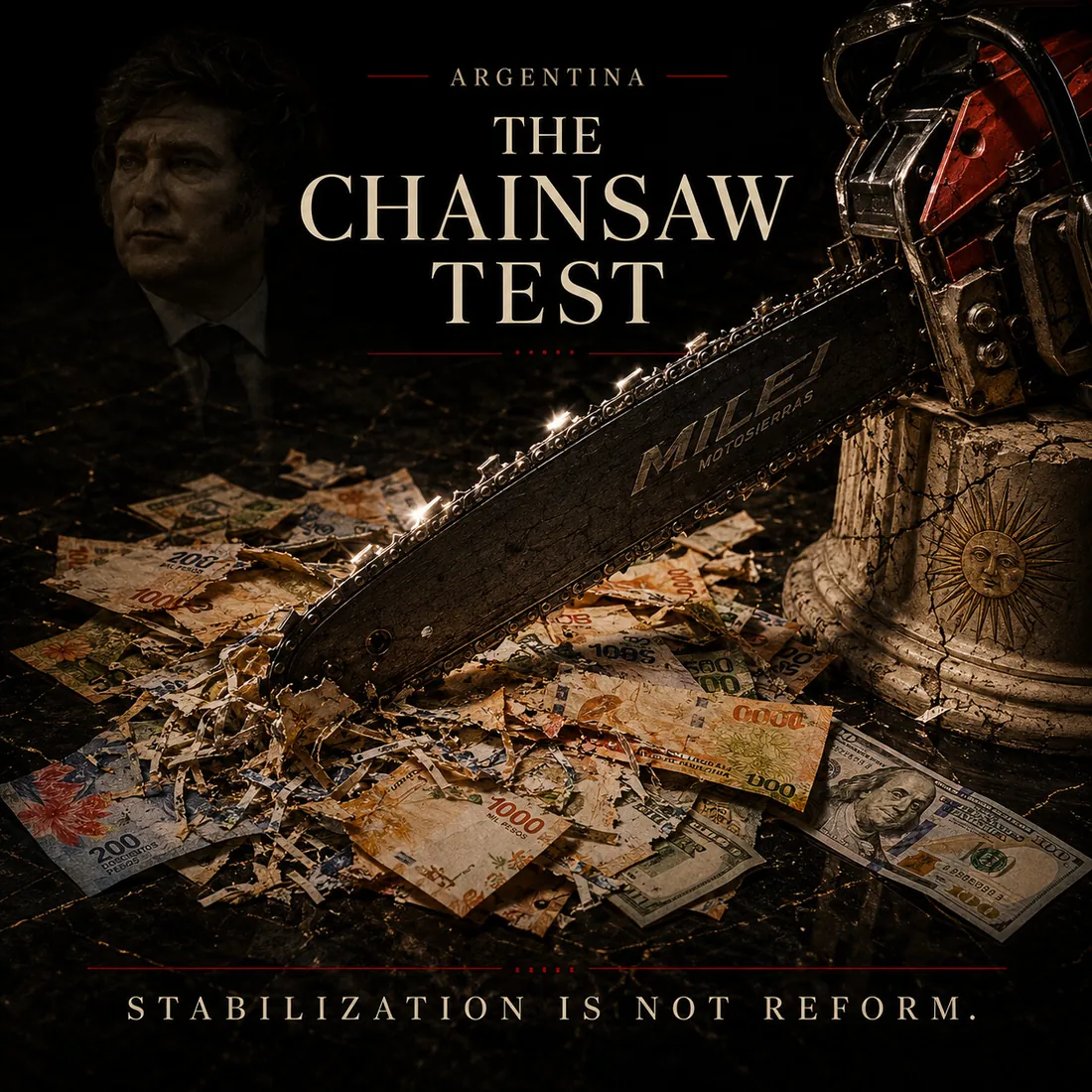
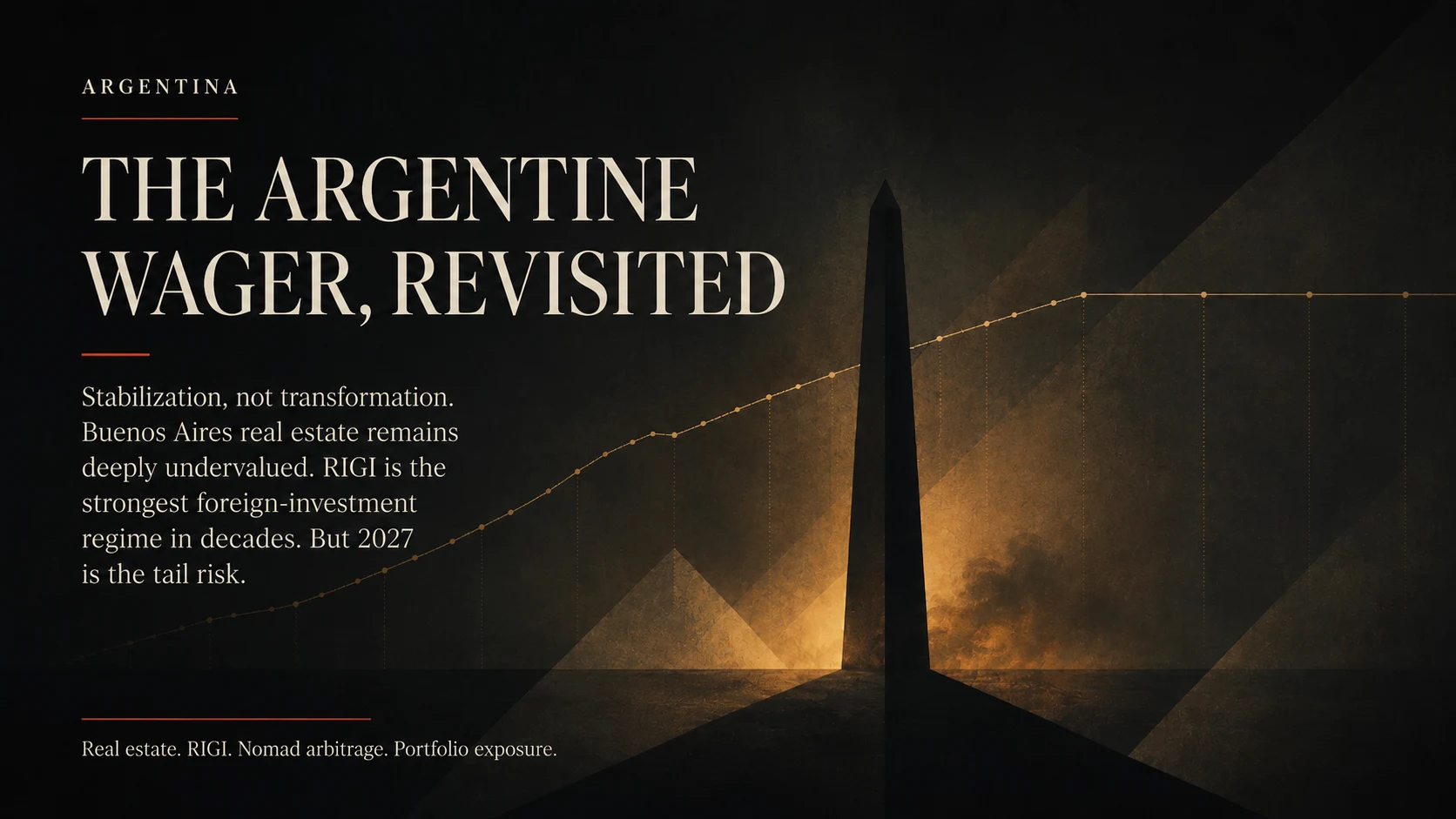
With the cepo lifted and the blue-dollar gap gone, is Milei's Argentina investable again? It is a stabilization story with recovery potential — and the distinction is the whole trade.
The last time Intelligent Internationalist looked at Argentina, it was February 2025. The cepo was still on. The blue dollar traded at a 30% premium to the official rate. Nobody knew whether Javier Milei would survive the October midterms, much less whether his currency experiment would hold.
Sixteen months later, the picture has shifted substantially, and so have the questions. The capital controls are gone. Inflation is down from a ~211% peak to roughly 33% year-over-year. The fiscal deficit has vanished. Milei’s party won a commanding plurality in the midterms. The IMF signed a $20 billion program. And the US Treasury, in an extraordinary move, intervened directly in the Buenos Aires foreign exchange market to prevent a peso collapse.
The question is no longer whether the experiment is working. It is whether the gains are durable, and who, exactly, should be writing checks.
The shock that worked
The chain of events is remarkable by any standard.
In December 2023, Milei inherited an economy with 211% annual inflation, a budget deficit of about 5% of GDP, and central bank reserves that his predecessor had drained to near-zero in a pre-election spending spree. His response was textbook shock therapy: a maxi-devaluation of the peso, brutal fiscal consolidation that eliminated the deficit within months, and a crawling peg that forced the currency to depreciate at 2% per month (later 1%), providing a nominal anchor for prices.
The result was a crushing recession through early 2024. Poverty spiked to 53%. But inflation collapsed from over 20% monthly to low single digits. By April 2025, with an IMF program locked in, Milei scrapped most capital controls and moved to a managed float within a peso band. On January 1, 2026, the band’s edges began widening at the lagged inflation rate rather than a fixed monthly crawl, a more flexible corridor.
The blue dollar, that unofficial parallel market that had been the real price of money in Argentina for over a decade, effectively ceased to exist as a separate entity. The gap closed. You can now buy dollars at something approximating a single, market-facing rate.
By mid-2026, the numbers look like this: GDP grew roughly 4.4% in 2025 and is projected at 3.5–4% for 2026. Monthly inflation hovering stubbornly around 2%: not conquered, but no longer a crisis. Poverty down to 28.2%, the lowest since 2018. A fiscal surplus maintained across most quarters. And perhaps most telling: Argentines, freed from the cepo, bought more than $35 billion in foreign currency in the first year of liberalization: a vote of no-confidence in the peso, or of confidence in the system, depending on how you read it.
The fragility the numbers don’t show
Maurice Obstfeld, former chief economist of the IMF and now at the Peterson Institute, published the most important analysis of the Milei framework in February 2026. It deserves careful reading by anyone considering a bet on Argentina.
His core argument: the new exchange rate band, which expands at the rate of inflation from two months prior, eliminates mechanical real appreciation of the peso, an improvement over the crawling peg. But it sacrifices the nominal anchor. “The lagged indexation of the exchange rate to inflation imparts a greater degree of inertia to inflation,” Obstfeld writes. Because whatever inflation the economy produces in a given month becomes the maximum depreciation rate two months later, “the scheme encourages inflation.” Weak anchor. Circular logic. This is not a framework built for permanent stability; it is a framework built to buy time.
The evidence is already visible. Monthly inflation has been stuck at roughly 2% (a floor, not a ceiling) and accelerated slightly from the 1.5% low in May 2025. The Central Bank has abandoned its policy rate in favor of targeting the money supply, a strategy that sounds disciplined but depends on forecasting money demand in a dollarized economy where Argentines can switch between pesos and dollars on instinct. Get the forecast wrong, and you’re either feeding inflation or starving the recovery.
Then there is the September–October 2025 episode, which should terrify anyone who thinks the currency risk has been solved. When Milei’s party was trounced in Buenos Aires provincial elections in September 2025, markets panicked. The peso shot toward the top of its band. Dollar reserves hemorrhaged. The JPMorgan EMBI spread on Argentine bonds blew out to nearly 1,500 basis points. The central bank was forced into heavy dollar sales. The entire program came within days of breaking, saved only by an extraordinary and politically contentious $20 billion US Treasury swap facility and a reported $2.5 billion in direct FX market intervention by Washington.
The new framework could prove fatal, and perhaps beyond even Milei’s escape-artist skills.
Maurice Obstfeld, Peterson Institute for International Economics
That is about as close to a flashing red light as a former IMF chief economist is permitted to issue.
What is actually investable
The investment case splits into four distinct lanes. They are not the same bet.
Lane 1: The real estate buyer. Buenos Aires apartments trade at roughly $2,200 to $3,500 per square meter, down 30–40% from peak in real terms. Recoleta and Palermo, neighborhoods that rival Paris or Madrid in architectural quality, deliver value that is objectively absurd by global standards. A 60-square-meter apartment in a good building can be had for $140,000 to $160,000. Property taxes run 0.1–0.3% of market value annually. Foreigners face zero ownership restrictions under Article 20 of the Argentine Constitution. You need only a CUIT tax ID and a licensed notary.
But the catch is structural: there is no mortgage market for foreigners. The purchase is all-cash. Closing costs run 7–10%. Owning Argentine real estate is a capital appreciation play, not a yield play. Rental yields in Buenos Aires hover at a gross 5–7% and net considerably less. You are betting on Argentina’s recovery, not collecting a check while you wait. And if the currency framework breaks again (and Obstfeld is not alone in warning it might), your dollar-denominated asset may hold value while the local economy around it contracts. That is not the worst scenario, but it is not a passive one either.
Lane 2: The productive investor. This is where the Milei administration has done its most consequential work. The RIGI framework (Régimen de Incentivos para Grandes Inversiones) offers tax and legal concessions for large-scale investments in energy, mining, agribusiness, and technology: the sectors where Argentina has genuine comparative advantage. Vaca Muerta shale. Lithium in the northern provinces. Agricultural exports unlocked by reduced export duties. This is not a bet on the peso. It is a bet on Argentina’s real assets, dollar-denominated output, and export capacity: the same playbook that worked for Chile’s mining sector and has quietly powered Peru’s growth for two decades.
The IMF’s initial 5.5% growth projection for 2025 (actual growth landed closer to 4.4%) was led disproportionately by these sectors. And the October 2025 midterm result, with Milei’s party unexpectedly strengthened, increases the probability that RIGI survives a change of government, because it is now law, not decree.
The risk: Peronism remains the most likely alternative in 2027, and its default posture toward foreign extraction is suspicion if not outright hostility. A Kirchnerist restoration would not necessarily repeal RIGI (the fiscal reality may make that impossible), but it would almost certainly introduce new friction. The horizon is three years. Plan accordingly.
Lane 3: The lifestyle nomad or retiree. Argentina offers a genuinely attractive quality of life at a fraction of US or European costs. Buenos Aires is one of the world’s great walking cities. The food is excellent. The culture is deep. The cost of eating out (a proper steak dinner for two at $30–50) is roughly one-third of the equivalent in New York or London.
The digital nomad visa exists but is not particularly generous or streamlined compared to Portugal or Spain. Property ownership does not confer residency rights. And while day-to-day living costs are low in dollar terms, the unreliability of utilities, banking, and government services remains real. Argentina is a country where things work until they don’t, and when they don’t, there is no customer service department that picks up the phone.
The poverty rate is 28.2%, meaning more than one in four Argentines cannot meet basic needs. Anyone moving to Argentina to enjoy the discount should understand what that discount is priced off of. The lifestyle play works. But it requires a tolerance for volatility that most American and European retirees do not actually possess.
Lane 4: The financial portfolio investor. Argentine sovereign bonds carry spreads that reflect genuine default risk. The Milei administration is servicing its debts and has maintained IMF program compliance. But the external debt profile remains heavy, reserves remain thin, and the fiscal surplus depends on continued austerity: a political variable, not a structural one. Anyone allocating to Argentine paper is making a high-yield distressed bet, not a convergence trade. That may be appropriate for a small slice of a risk-tolerant portfolio. It is not a retirement allocation.
The counter-perspective
The left-wing critique of Milei is not hard to construct, and it deserves to be steelmanned rather than dismissed.
The poverty spike to 53% in early 2024 was not a collateral effect; it was the direct result of policies that Milei chose. The poverty decline to 28.2% is real, but it is a recovery from an induced catastrophe, not evidence that the baseline has been raised. The fiscal surplus was achieved by slashing pensions, public-sector wages, and transfers to the provinces: the same social safety net that Argentina’s poor depend on. The cancellation of public works projects and the deregulation of rental markets, while efficient in the aggregate, created genuine hardship for the most vulnerable.
The Página/12 left argues, with some justification, that Milei’s success in reducing inflation came at the cost of “impoverishing the population.” The fact that inflation was worse under Fernández does not make the current hardship acceptable to those experiencing it. Inequality, while improved from the Q1 2024 spike, is back to where it was in early 2023, meaning the structural distribution of income in Argentina has not budged.
The environmental critique is also substantive: RIGI fast-tracks mining and fossil fuel extraction with reduced regulatory oversight. The lithium rush in Jujuy and Catamarca is proceeding with limited consent from indigenous communities. Vaca Muerta’s fracking boom carries water-contamination risks in a region that is already arid.
These are not frivolous objections. A serious investor prices them in. A serious country addresses them. Argentina, under Milei, is doing the first but not yet the second.
The bottom line
Argentina under Milei is not a recovery story. It is a stabilization story with recovery potential. The distinction matters.
The cepo is gone. The blue-dollar gap is gone. Inflation is manageable, not cured. The fiscal house is in order, but the foundation is political will, not institutional permanence. The next presidential election is October 2027, and the Peronist alternative has not gone anywhere; it merely lost a midterm.
For the cash-rich real estate buyer with a ten-year horizon: Buenos Aires at $2,300 per square meter is among the most undervalued urban real estate plays on earth. The transaction costs are high, the currency risk is real, and you must pay cash. But if you believe the country has bottomed (and the evidence is stronger for that proposition today than at any point since 2017), the entry point is compelling.
For the productive investor in energy, mining, or agriculture: the RIGI framework is the most investor-friendly regime Argentina has offered in decades, and it is now encoded in law. The US–Argentina bilateral relationship is warmer than at any point since Menem. The infrastructure is bad but improving. The labor force is skilled. The geology is world-class. If you can tolerate a three-year political horizon and a non-zero risk of a 2027 reversal, the risk-reward is asymmetric in your favor.
For the lifestyle seeker: come for six months. Rent in Palermo. Eat the steak. Learn enough Spanish to read La Nación. Do not buy unless and until you understand that Argentine real estate is a capital appreciation play with zero yield support and no mortgage market. The quality of life is real. So is the volatility. Decide whether you can live with both.
For the passive financial investor: wait. Argentine sovereign risk is not priced for entry. The bond market still carries a default premium that reflects genuine uncertainty about what happens after 2027. You do not need to be first into this trade. Let the next election resolve the political tail risk before committing capital.
Milei has done something genuinely difficult: he stabilized an economy that three presidents before him could not. The achievement is real. But stabilization is not transformation. The institutions are still weak. The central bank is still improvising its monetary framework. The dollar reserves are still inadequate. And the social compact, the agreement between the Argentine state and its citizens about what the state owes and what it can afford, remains unwritten.
The wager is better today than it was in 2024. It is not yet safe. Invest accordingly.