
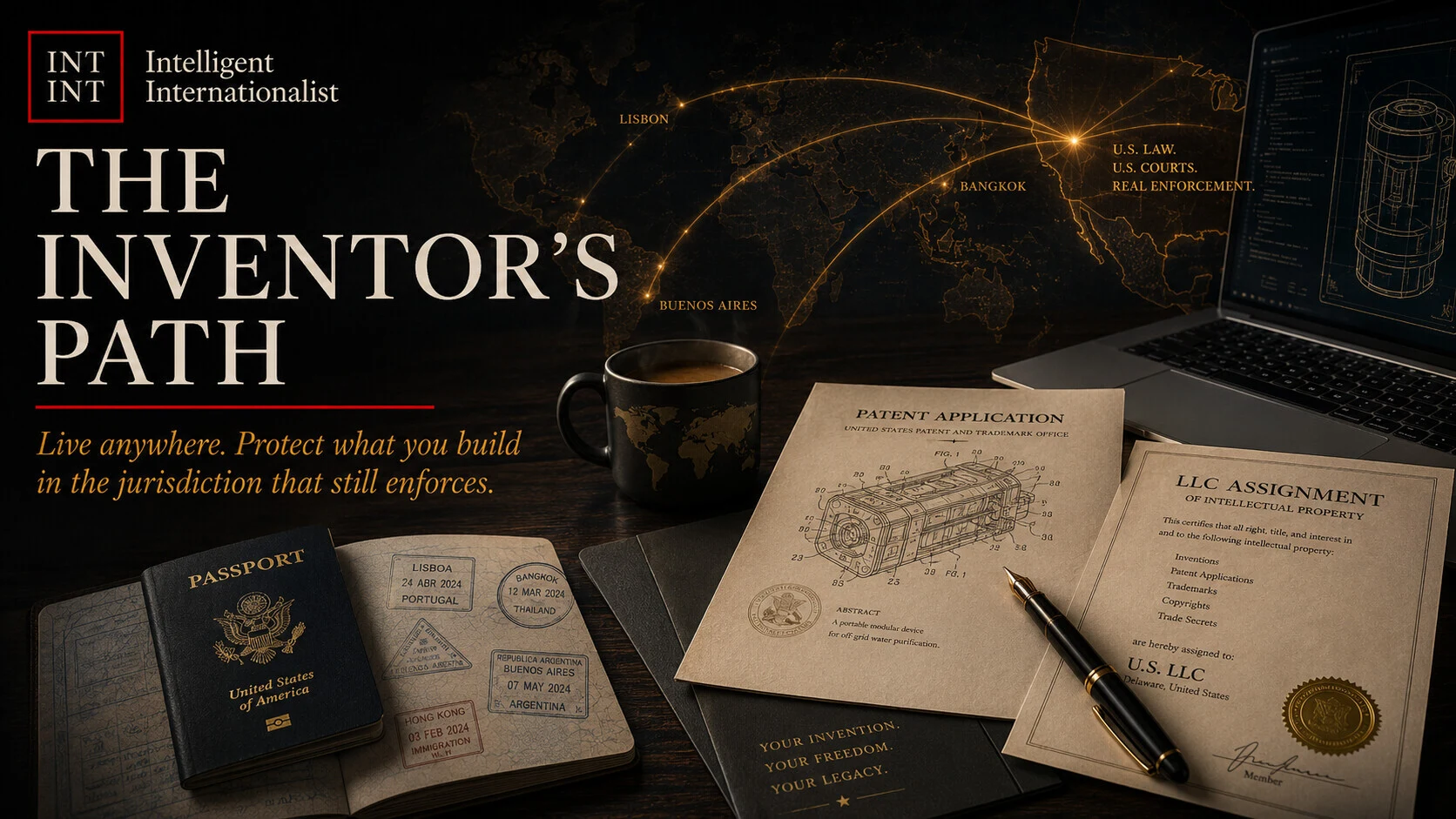
If you are building something worth protecting, the question of where and how to protect it is one of the highest-leverage decisions you will make. And the answer, more often than not, starts in the United States.
Most people think about building abroad in terms of laptops, co-working spaces, and visa runs. They do not think about patents. That is a mistake. If you are building something worth protecting, the question of where and how to protect it is one of the highest-leverage decisions you will make. And the answer, more often than not, starts in the United States.
The American patent system is not perfect. It is expensive, slow, and favors those who can afford good counsel. But here is what it does that almost no other jurisdiction does at the same scale: it actually enforces. A US patent gives you the right to exclude others from making, using, or selling your invention in the world’s largest consumer market. If someone infringes, you can sue in federal court. You can seek injunctions. You can recover damages. The system has a functioning judiciary, specialized patent courts, and a body of case law that makes outcomes reasonably predictable. That combination of enforcement, predictability, and market size is vanishingly rare.
The rest of the world is a different story. China files more patents than any other country by volume roughly 1.8 million invention patent applications in 2024, the most recent year with complete data from WIPO. The United States followed with 603,194. But a Chinese patent is a very different instrument from an American one. Enforcement is erratic. Courts are subject to political pressure. Foreign entities face structural disadvantages in litigation. A patent you cannot enforce is a certificate, not a weapon. Notably, China’s 1.8 million figure excludes utility models a separate, lower-standard IP right that accounts for an additional 3.2 million Chinese filings. The invention patent number alone is more than triple the USPTO’s total.
Japan, Korea, and Europe all have strong systems. In 2024, Japan’s patent office received 306,855 applications, Korea’s received 246,245, and the European Patent Office received 199,402. These are serious jurisdictions with functioning courts. But they are national or regional systems. A patent in Japan protects you in Japan. A European patent protects you in Europe. That matters if those are your markets. For most English-language inventors and entrepreneurs, the primary market is the United States.
The US is the primary market. And the US system, for all its flaws, is the closest thing to a global enforcement backstop that exists. That is the moat.
Can a Foreigner Own a US Patent?
Yes. But there is a critical distinction most articles miss. The USPTO does not care about your passport. It cares about your domicile.
The USPTO does not require US citizenship to file a patent application. A Colombian citizen, a French citizen, a Brazilian citizen, anyone can file. A foreign individual or a foreign-registered company can be listed as the applicant and the assignee. The patent issues in the name of whoever is listed on the assignment.
The question of who must hire a US-registered patent attorney is different. And it changed on July 20, 2026.
Effective July 20, 2026, the USPTO requires all patent applicants and patent owners whose domicile is not within the United States or its territories to be represented by a registered patent practitioner. The USPTO defines domicile as “the permanent legal place of residence of a natural person or the principal place of business of a juristic entity.” It determines domicile based on the residence address you put on your application data sheet.
Here is what that means in practice. A US citizen who lives in Medellin has a foreign domicile. They must hire a US-registered patent attorney. A Colombian citizen who lives in Miami has a US domicile. They can file pro se, without an attorney, just like any other US resident. The USPTO explicitly considered and rejected a carve-out for US citizens living abroad. Citizenship data is not collected. Domicile is what matters.
The rule does not block anyone from obtaining a filing date. A foreign-domiciled applicant can submit an application and receive a filing date even without an attorney’s signature. But all follow-on paperwork amendments, information disclosure statements, petitions, the application data sheet itself must be signed by a registered practitioner. The USPTO will mail a notice giving you time to find one.
This is not a barrier designed to keep people out. It is a harmonization measure. Most other countries already require foreign applicants to use a locally licensed representative. The USPTO is catching up. It also serves an enforcement purpose: registered practitioners are subject to USPTO disciplinary rules, including duties of candor and cooperation. A pro se applicant in Bangkok cannot be meaningfully disciplined by the USPTO. A registered attorney in Chicago can lose their license.
For the international inventor, the practical takeaway is simple. If your permanent legal residence is outside the United States regardless of what passport you carry, you need a US-registered patent attorney or agent. If your permanent legal residence is inside the United States, you do not. The passport in your drawer is not the variable. The address on your application is.
What International Inventors Actually File
The USPTO is not just for hardware engineers and pharmaceutical companies. The things international inventors and expat entrepreneurs build fall squarely into patentable and registrable categories. Here is what the USPTO handles and what it costs.
Practical question: if you write an ebook, design a SaaS platform, create a physical product, or build a brand, what do you actually file?
For a physical product or a software process that is new and non-obvious, you file a utility patent. This is the standard patent everyone thinks of. It protects how something works. A utility patent lasts 20 years from the filing date and requires maintenance fees at years 3.5, 7.5, and 11.5 to stay in force.
For a product design, the look of something rather than how it works, you file a design patent. This protects the ornamental appearance. A design patent lasts 15 years from the date of grant and does not require maintenance fees.
For your brand name, logo, or product name, you file a trademark with the USPTO. This is not a patent but is handled by the same office. A trademark protects your brand identity in commerce.
For written works like ebooks, courses, blog content, and code, you do not file with the USPTO at all. These are protected by copyright, which is handled by the US Copyright Office, a separate agency. Copyright is automatic upon creation, but registration gives you the right to sue for statutory damages and attorney’s fees.
A quick breakdown. Your ebook is not patentable, but the software platform that delivers it might be. Your course content is copyright, but the brand name is a trademark. Your physical product design might need a design patent for the look and a utility patent for the mechanism. Most international inventors will interact with at least two of these systems.
Now the fees. The USPTO uses three entity size tiers that determine what you pay. Under the Unleashing American Innovators Act of 2022, micro entities save 80 percent and small entities save 60 percent off standard fees. These are the official numbers from the USPTO fee schedule, current as of July 2026.
Micro entity: You qualify if your gross income is below the USPTO’s published maximum qualifying gross income currently $251,190 and you have fewer than five prior USPTO applications. You save 80 percent. A full utility patent filing, search, examination, and issue fees totals $658 in USPTO fees as a micro entity.
Small entity: Fewer than 500 employees including affiliates. You save 60 percent. Same utility patent: $1,246. (Note: small entities get a special $70 electronic filing rate.)
Large entity: Everyone else. Same utility patent: $3,290.
Starting with a provisional patent application is the cheapest entry point. A provisional costs $65 as a micro entity or $130 as a small entity. It establishes your priority date and gives you 12 months to file the full non-provisional application. It does not get examined. It does not become a patent. It is a placeholder but a powerful one, because US patent law is first-to-file. Whoever gets their priority date locked in first wins.
Attorney fees add $5,000 to $15,000 for a well-prepared utility application, and more if the prosecution gets complicated. That is the real cost. The USPTO fees are the cover charge. The attorney is the ticket.
Design patents are cheaper. Total USPTO fees run $520 for a micro entity, $1,040 for small entity. No maintenance fees. Fifteen years of protection for the way your product looks.
Trademarks are the most accessible. The USPTO retired the old TEAS Plus and TEAS Standard systems in January 2025. The current base application fee is $350 per class of goods or services, filed through the Trademark Center. Many entrepreneurs start here protect the brand name, register the logo, and worry about patents when the product is proven.
The IP Holding Company: Where You Live Matters
This is where most generic advice falls apart. Every article about IP holding companies says the same thing: form a Delaware LLC or a Wyoming LLC. That advice is not wrong, but it is incomplete. It ignores the single most important variable: where you actually live.
Here is the rule most people miss. If you form a Wyoming LLC but you live and operate your business from Florida, Florida considers that Wyoming LLC a foreign entity doing business in Florida. You are legally required to foreign-qualify that Wyoming LLC in Florida. That means filing paperwork with the Florida Secretary of State, paying Florida’s $100 filing fee plus $25 for a registered agent, and filing an annual report in Florida. You are now paying to maintain an LLC in two states instead of one.
California is worse. Foreign-qualifying an out-of-state LLC in California triggers the state’s $800 minimum annual franchise tax, every year, regardless of whether the LLC makes a dime. If you live in Los Angeles and someone told you to form a Wyoming LLC for asset protection, they just bought you an $800 annual bill you did not need.
The general rule is this. If you have a fixed US residence in a single state and your business operates from that state, form the LLC in your home state. The simplicity is worth more than the marginal benefits of Wyoming or Delaware law. A Florida LLC holding a patent in Florida works fine. A Texas LLC holding a patent in Texas works fine. Patent law is federal. The state of incorporation does not change your patent rights. It only changes the corporate governance rules, the privacy of your ownership records, and the asset protection features of your LLC.
Now the exception. If you do not have a fixed US residence (someone with no state domicile, or a US citizen living abroad full-time with no plans to return to a specific state), then the Wyoming or Delaware play makes sense. Wyoming offers stronger charging order protection for single-member LLCs, meaning a creditor with a personal judgment against you generally cannot force the sale of LLC assets. They can only get a charging lien on distributions. Delaware has the Court of Chancery, a specialized business court that handles disputes without juries, making litigation faster and more predictable. Both are excellent for holding companies that do not physically operate anywhere.
The key distinction is this: are you domiciled in a US state, or are you truly rootless? Answer that first. Then choose your formation state.
Now the entity type. For holding a patent, an LLC is the standard choice for solo inventors and small teams. It is simpler than a C-corporation, avoids double taxation through pass-through treatment, and provides adequate asset protection. A C-corporation can also hold patents and is sometimes preferred if you plan to raise venture capital or issue equity to employees, but it introduces a separate tax return and corporate formalities. For the solo inventor, the LLC is almost always the right answer.
Assignment is the final step. The inventor assigns the patent rights to the LLC through a formal assignment document recorded with the USPTO. The LLC owns the patent. The inventor owns the LLC. If the inventor wants to license the patent to their own operating business, they do so through a licensing agreement between the two entities. Royalties flow to the holding LLC. The operating company deducts the royalty as a business expense. This is the same structure Fortune 500 companies use. It scales down.
The PCT: Your Global Option, Not Your Global Solution
The Patent Cooperation Treaty, administered by WIPO, lets you file one international application and designate 158 member countries. It buys you time (typically 30 months from the priority date) to decide which countries you actually want to pursue. It does not grant a patent. It is a placeholder that preserves your right to file nationally later.
Most inventors will file a US provisional first, then a PCT application claiming priority to that provisional, then enter the national phase in the US plus a handful of other countries where they actually intend to do business. The PCT is a routing tool, not a protection tool. The protection comes from the national patents you eventually obtain.
The cost scales with ambition. A PCT application itself runs a few thousand dollars in fees. Each national phase entry adds translation costs, local attorney fees, and government filing fees. A full global portfolio across ten jurisdictions can easily exceed six figures before the first patent issues. Most solo inventors file in the US only, or the US plus the European Unitary Patent, and call it a day.
The International Hotspot Report Card
Here is how the major international destinations stack up for patent protection and IP enforcement.
South America. Brazil, Mexico, and Colombia are all PCT members. You can obtain patents in each. The problem is enforcement. Brazil’s patent office, the INPI, historically had grants that took over 10 years, though the office has been working to reduce the backlog. Mexico’s IMPI is faster but underfunded. Colombia’s system exists on paper but sees very little patent litigation. If you invent something in Medellin and need to stop a competitor from copying it, do not expect the Colombian courts to move quickly or predictably. These are registration systems, not enforcement systems.
Europe. The European Unitary Patent, launched in June 2023, now covers 18 EU member states including Germany, France, Italy, and the Netherlands. One application, one grant, one court (the Unified Patent Court) for enforcement and revocation. This is a legitimate, world-class system. Eastern Europe is covered where individual countries have ratified. Poland has not joined the UPC but has its own functioning patent office and courts. Romania joined in September 2024. The European system is the only regional system that rivals the US in enforcement quality, and for certain technologies it may be superior, particularly in pharmaceuticals and mechanical engineering where German courts have deep expertise.
Southeast Asia. Vietnam is the standout. Patent applications from Vietnam grew 75.4 percent between 2023 and 2024, the fastest rate among the top 20 IP offices worldwide, according to WIPO. The government has been actively modernizing its IP framework to align with international standards as part of its broader push to attract tech investment. Thailand is a PCT member but enforcement is weak and the courts are slow. Indonesia received 10,902 patent applications in 2024 and rose to 17th place globally, but most were filed by foreign entities and the domestic enforcement infrastructure is still developing. Cambodia and the Philippines are further behind. If you are building a tech product and spending time in Chiang Mai or Da Nang, file your patent in the US or Europe. Do not rely on local protection.
The Strategic Playbook: How It Is Actually Done
Here is the step-by-step path, grounded in how real solo inventors and small teams navigate this. This is a pattern, not legal advice. Every situation is different. Hire your own counsel.
Step 1. File a US provisional patent application.
This is your first move and the most time-sensitive one. A provisional application costs $65 as a micro entity or $130 as a small entity. It does not require formal patent claims. It does not get examined. What it does is lock in your priority date with the USPTO. Under the first-to-file system, the date your provisional hits the USPTO is the date that matters. If someone else files for the same invention a month later, you win.
You can write a provisional yourself if you are technical enough to describe your invention in detail, including drawings, diagrams, and a written description that would enable someone skilled in the field to build it. Most inventors hire a patent attorney even for the provisional, because a poorly written provisional is worse than no provisional. It can limit your future claims. A provisional costs $2,000 to $5,000 with an attorney, depending on complexity.
You now have 12 months. Use them well.
Step 2. Determine your domicile and form the right entity.
If you live in a US state and operate your business from that state, form the LLC there. A Florida resident forms a Florida LLC. A Texas resident forms a Texas LLC. This keeps your life simple. You pay one state’s fees. You file one annual report. You do not trigger foreign qualification requirements.
If you are someone with no fixed US state domicile, or a US citizen living abroad full-time, form in Wyoming or Delaware. Wyoming gives you stronger charging order protection and lower annual fees. Delaware gives you the Court of Chancery for dispute resolution. Both work. Pick one and form the LLC.
Step 3. Execute the patent assignment.
Once the LLC exists, you sign a formal patent assignment document transferring all rights to the invention from yourself, the inventor, to the LLC, the assignee. This document is recorded with the USPTO’s Assignment Recordation Branch. The fee is minimal, typically under $50. Once recorded, the LLC is the legal owner of the patent rights.
This is not optional paperwork. If you die, get sued personally, get divorced, or want to sell the patent, the assignment is the document that determines who owns what. Do not skip it.
Step 4. File your non-provisional utility patent, design patent, or PCT application before the 12-month deadline expires.
If you are staying US-only, file the non-provisional utility application claiming priority to your provisional. Total USPTO fees: $658 for micro entity or $1,246 for small entity for filing, search, examination, and issue. Attorney fees for a well-prepared non-provisional run $8,000 to $15,000.
If you want international options, file a PCT application before the 12-month deadline instead of or in addition to the US non-provisional. The PCT buys you another 18 months (30 months total from your provisional date) to enter the national phase in specific countries.
Step 5. Separate operations from IP.
If you are selling products or services that use the patented invention, do not run that business through the same LLC that holds the patent. Form a separate operating entity, such as another LLC or a sole proprietorship. The operating entity licenses the patent from the holding LLC. It pays royalties. Those royalties are a deductible business expense for the operating entity and income for the holding LLC.
The reason is protection. If your operating business gets sued (by a customer, a competitor, a landlord), the patent is not an asset of the sued entity. It sits safely in the holding LLC. This is the same structure Apple uses. It is not exotic. It is basic corporate hygiene.
Step 6. At each national phase deadline, decide which countries are worth it.
Thirty months after your provisional filing date, you must decide which countries you actually want patent protection in. For each country, you pay translation costs, local attorney fees, and national filing fees. Most solo inventors choose the US only, or US plus Europe. Filing in ten countries is rare unless you have a clear market in each. The cost of a single national phase entry ranges from $3,000 to $10,000 depending on the country and the complexity.
Be honest about where your customers are. A patent in Japan is useless if no one in Japan is buying your product. File where you sell.
Why This Matters More Than People Think
The location-independent lifestyle is sold as freedom. Work from anywhere. Live cheap. See the world. What is rarely discussed is the asset protection vacuum that lifestyle creates. When you have no fixed address, no home jurisdiction, and your income streams are digital, you are structurally exposed. A judgment against you in one country can follow you to another. A competitor can copy your product and you have no obvious forum to stop them.
The US patent system, combined with a properly structured holding entity that matches your actual domicile situation, is the counterweight. It anchors your most valuable asset in the jurisdiction with the strongest enforcement. It gives you a sword and a shield. It turns a vulnerability into a competitive advantage.
Most people think patents are for corporations and patent trolls. They are also for the solo inventor who wants to build something real, protect it, and keep building, no matter where in the world they wake up.
None of this is tax advice or legal advice. It is a pattern observed across dozens of cross-border entrepreneurs and inventors. Every situation is different. Hire a registered US patent attorney. Hire a cross-border tax professional who understands your specific countries. The money you spend on structure is the cheapest insurance you will ever buy if someone tries to copy what you built.