
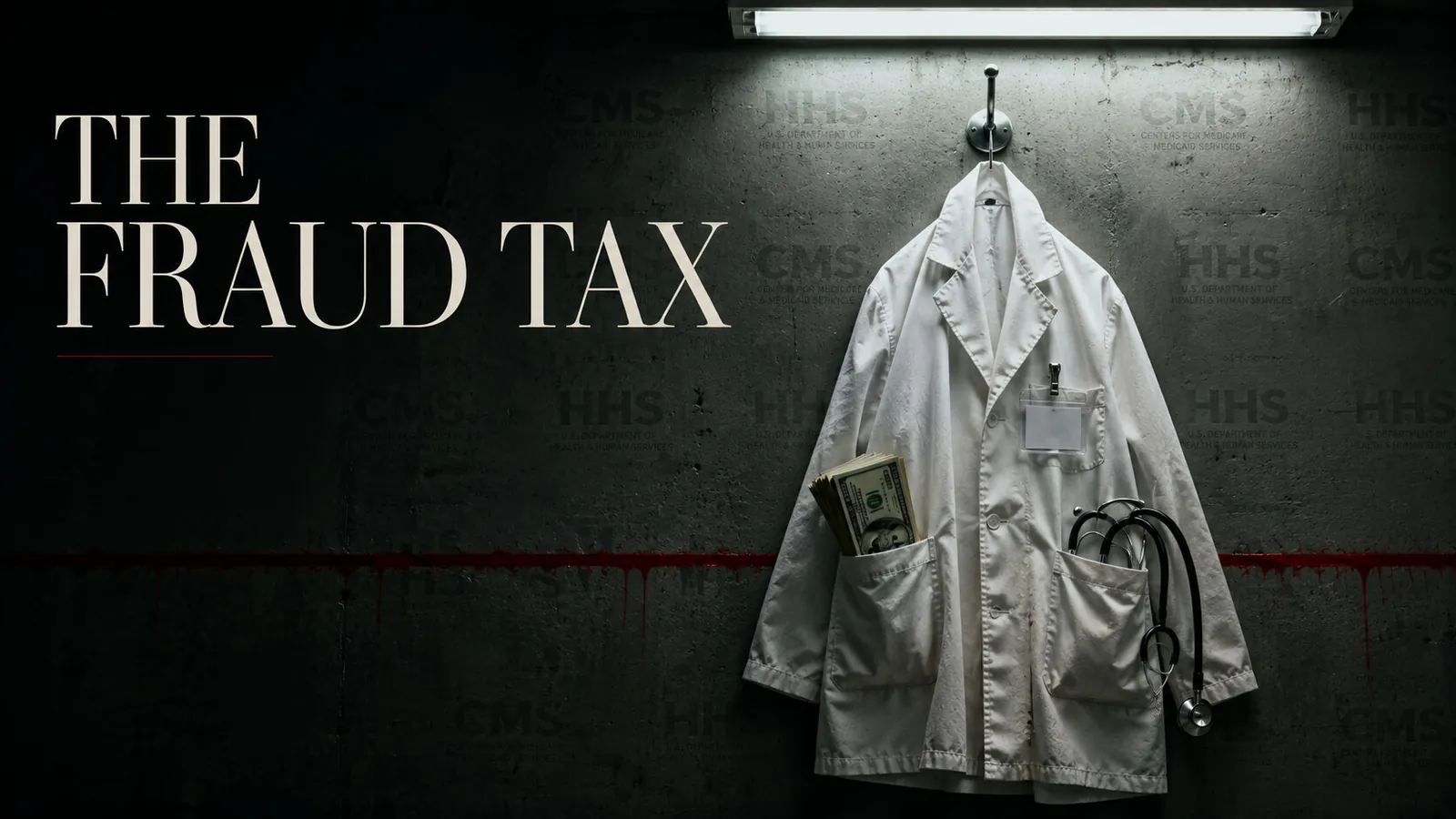
America claims to be the wealthiest country on earth. The balance sheet has a hole in it measured in hundreds of billions a year — and the people drilling it wear white coats, not ski masks.
Recently, on June 23, 2026, the Department of Justice announced the results of its annual National Health Care Fraud Takedown. Four hundred and fifty-five defendants charged. Ninety of them doctors and licensed medical professionals. Six and a half billion dollars in alleged false claims. Operations across 56 federal districts and 45 states. Fugitives captured in Cyprus, Estonia, and the Philippines. Over $182 million seized in cash, luxury vehicles, and jewelry.
One year earlier, the DOJ charged 324 defendants in a $14.6 billion takedown, the largest in American history at the time. Combined, across just two coordinated operations: 779 defendants, $21.1 billion in alleged fraud.
Start there, because everything else flows from it. When Americans argue about the cost of healthcare (premiums that rise faster than wages, surprise bills, why an MRI costs $2,500 in Dallas and $300 in Barcelona) the conversation almost always lands on insurers, drug pricing, hospital consolidation. Those are real problems. But there is another line item on the bill that almost no one talks about, and it is measured in the hundreds of billions.
The leak
The Government Accountability Office reported that federal improper payments totaled $186 billion in fiscal 2025, up $24 billion, a 15% increase. More than half came from two programs: Medicare ($57 billion) and Medicaid ($37 billion). Add the Earned Income Tax Credit ($21 billion), ACA exchange improper subsidies (likely exceeding $25 billion in 2026 alone), and the COVID-era unemployment fraud GAO pegs at $100–$135 billion, and you are looking at recurring annual leakage in the hundreds of billions. Cumulatively, since 2003, the GAO estimates $3 trillion in improper payments across the federal government.
Not all improper payments are fraud. The Kaiser Family Foundation notes that 79% of Medicaid improper payments in 2024 were due to insufficient documentation or missing steps: errors, not crimes. The distinction matters. A missing signature is not the same as a nurse practitioner in Texas billing Medicare for $906 million in wound grafts and buying a Ferrari, a Bulgari necklace, and a Philippine beach resort with the proceeds. But the fraud alone is big enough to matter: even conservative estimates place the annual healthcare fraud figure at $60–$100 billion, before counting the pandemic-era fraud still being uncovered, prosecuted, and in many cases unrecovered.
The schemes
The 2026 takedown is worth reading in detail, not because it is unusual but because it is representative. The schemes are not sophisticated. They are brazen, and they repeat because the architecture invites them. In Arizona, a company marketed skin grafts to Medicare at a 2,000% markup ($1,450 per square centimeter for tissue that cost a fraction of that) with 40% kickbacks to providers, billing Medicare over $4 billion; one VP of sales took $24 million for homes, cars, and watches. CMS later realigned the rate to $127 per square centimeter, a single change that prevented an estimated $11/month premium increase for every Medicare beneficiary. That number, $11 times every enrollee, is the fraud tax made visible.
In Virginia, a mental-health co-owner allegedly bribed homeless individuals with hotel stays for their Medicaid numbers and billed $49 million for services never provided. In California, a hospice owner bought the personal information of deceased Medicare beneficiaries from a funeral-home employee, enrolled the dead in hospice, and fabricated back-dated records. In Illinois, a single defendant billed Medicaid for more than 500 hours of behavioral-health services per day, a mathematical impossibility flagged by the DOJ’s new Data Fusion Center; he had diverted $27 million and was arrested at the airport trying to flee. These are not edge cases. They are what the system produces when the incentives are aligned for extraction rather than care.
Why it keeps happening
The structural problem is not that there are criminals. Every system has criminals. It is that the American healthcare payment architecture is designed to pay first and ask questions later, or never. Medicare runs a “pay-and-chase” model: claims are paid on submission, investigations follow years later. Medicaid reimburses states without a federal cap: Washington pays roughly 70% of state spending, so a state that spends an extra dollar of its own money gets more than two back. The incentive is to spend, not verify. The ACA exchanges advanced subsidies on self-reported income with verification so weak that GAO investigators obtained coverage for fictitious applicants in 23 of 24 attempts.
The pandemic made it worse. Self-certification, relaxed documentation, and expanded telehealth without oversight were necessary for speed, and opened the gates. The Paycheck Protection Program posted a 19.2% improper-payment rate; the Shuttered Venue Operators Grant hit 68.9%.
Fraud, waste, and abuse are the symptoms. The underlying disease is a financing structure that rewards spending more than value and accountability.
Brian Blase, Paragon Health Institute
And the structure did not build itself. It was built by legislation, expanded by regulation, and protected by a political ecosystem in which the industries that benefit from open-ended reimbursement (insurers, hospital systems, pharma, brokers) are also among the largest political donors in the country. The incentives to keep the spigot open are distributed precisely among the actors with the most resources to protect them.
The enforcement shift
The current administration has made fraud enforcement a visible priority. CMS Administrator Dr. Mehmet Oz: “CMS is done playing catch-up. We’re deploying advanced data analytics to expose fraud networks, freeze suspicious payments, and shut down bad actors before they can do damage.” HHS Secretary Robert F. Kennedy Jr.: “If you use our health care system to enrich yourself at the expense of patients or the American people, we will find you, we will prosecute you, and we will hold you accountable.” The tools are changing: the DOJ’s Data Fusion Center deploys AI against the payment data; the Illinois defendant was caught within five days. CMS is building a Claims Core system with electronic attestation and identity verification, and the “One Big Beautiful Bill” closed the most-abused ACA enrollment periods and required income verification for subsidies.
This is real progress, but it is reactive progress, patching holes after the water is in the boat. The deeper question is whether the payment model can be redesigned to make fraud structurally difficult rather than enforcement-intensive. The countries that do this well (Estonia, Singapore, Denmark) assume verification at the point of transaction, not years after: digital identities, centralized registries, automated anomaly detection, price transparency as defaults. The United States has none of these at scale.
The fraud tax on you
The cost does not stay on the government’s balance sheet. It passes through. When CMS realigned that single wound-graft code, it prevented an $11 monthly premium increase for every Medicare beneficiary. That is one billing code, one scheme. Multiply by the hundreds uncovered in a single takedown, then by the schemes that go undetected, and the pass-through cost to every American with insurance (public or private) is material. Premiums rise. Taxes rise. The Medicare Trust Fund depletes faster. Hospitals that play by the rules compete against those that bill fraudulently: the honest operator loses, the fraudulent one buys a Ferrari. And that is before the second-order effects: the erosion of trust, the cynicism that says “they’re all stealing anyway,” and the diversion of resources that could make the system work better for the people who use it honestly.
The honesty of wealth
U.S. national health expenditure was $5.3 trillion in 2024 (18% of GDP, or $15,474 per person). No other developed country spends much more than 12–13%, and the outcomes do not justify the premium. The conversation about why almost always focuses on prices. Those are real. But embedded in the American cost structure is a fraud overhead no other developed country carries at comparable scale. It is not the largest component of the differential, but it is the most revealing: the same government that cannot verify whether a dead person is enrolled in hospice can, with enough political will, deploy AI fusion centers that catch fraud within five days. The capability exists. What was missing was the priority.
The wealth of a nation is not its gross output. It is what remains after the skimming stops.
If the United States is hemorrhaging $200–$250 billion a year in documented improper payments and fraud (plus an additional $600 billion in uncollected taxes), what is the country actually worth? Not what the GDP says, not what the bond market assumes, but what the net balance sheet looks like after the leakage is accounted for.
The bottom line
The 2026 takedown is a record. It is also an admission. That 455 defendants could allegedly extract $6.5 billion from federal health programs in a single operation (the second consecutive year of record-breaking takedowns) is not a story about law-enforcement success. It is a story about system-design failure. The enforcement is necessary, the analytics overdue, the political will welcome. But enforcement alone will not solve a problem built into the architecture. As long as the model pays first and verifies later, criminals will extract. As long as states can game federal formulas without consequence, they will. As long as brokers can earn $6,000 a day enrolling people who don’t know they’re covered, they will.
The fraud tax is real. It is paid by every American with a medical bill, an insurance premium, or a tax return. And the only durable answer is not more prosecutions. It is a system that makes fraud hard to commit in the first place.