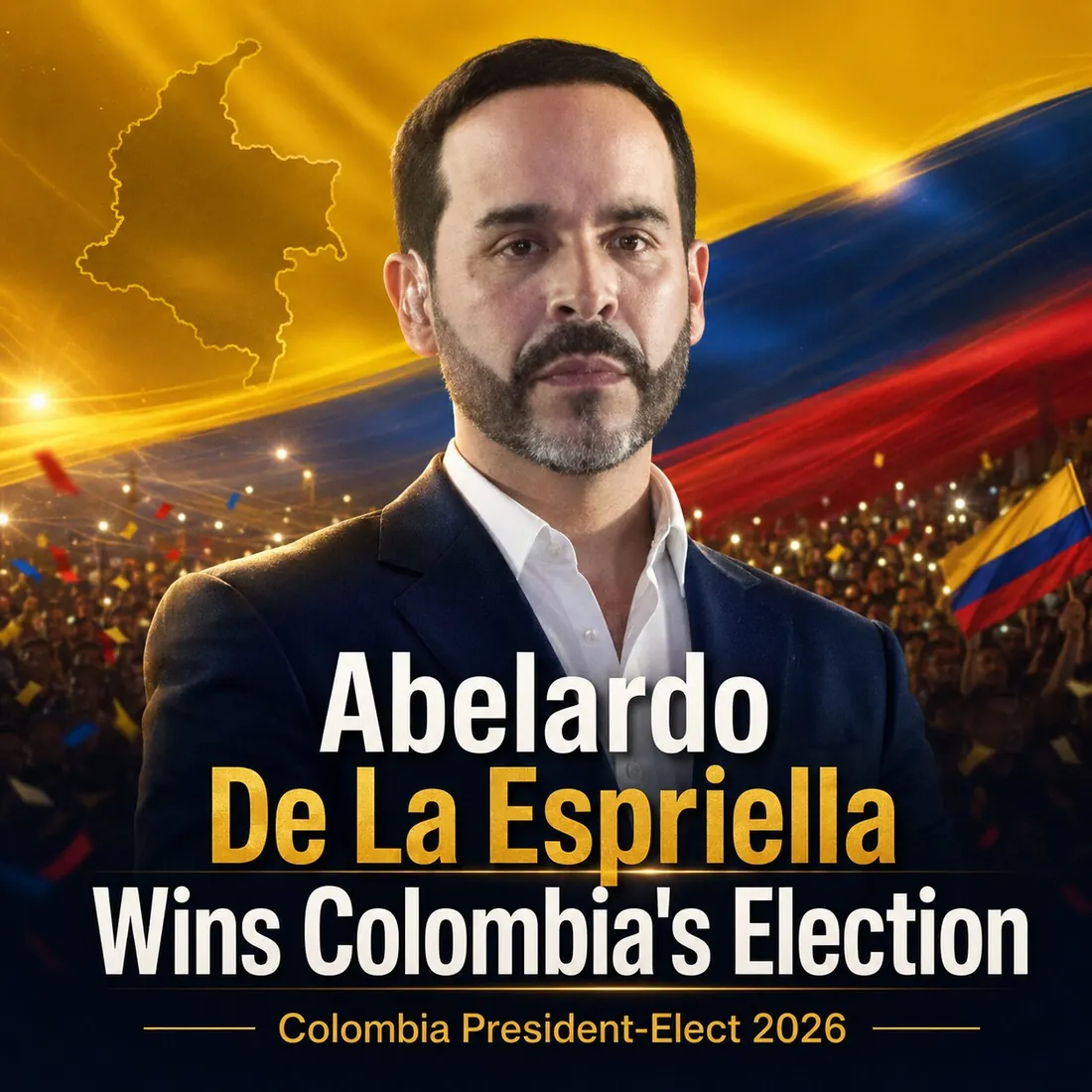
Colombia did not hold a normal transition of power today. It held the opening move of a confrontation.
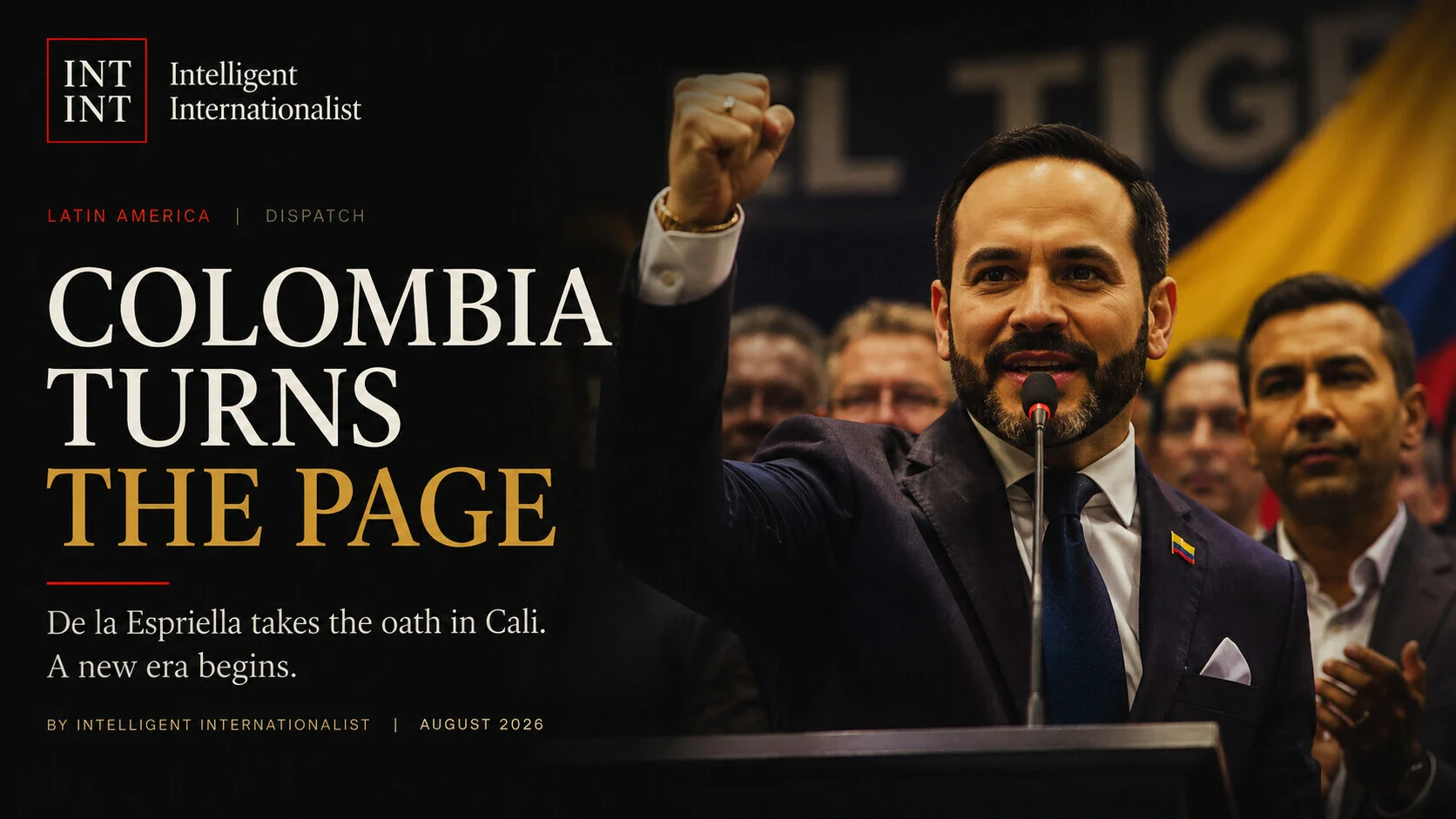
Eleven thousand troops. Drones grounded. Private vehicles banned from city roads. The 36th president of Colombia took the oath today in a university arena in Cali, not Bogota, while his predecessor stayed home and refused to acknowledge he had lost.
The last time a Colombian president was sworn in outside the capital, the year was 1898 and Rafael Nunez was too ill to travel to Bogota. This time the move was deliberate. Abelardo de la Espriella chose Cali because Cali is where the violence lives. The message was delivered before he spoke a word.
Why Cali
Bogota is the political capital. Cali is the city that has absorbed more drug violence, more gang warfare, and more displacement than almost any other urban center in the country. It sits at the crossroads of the Pacific cocaine route and the Cauca Valley, where armed groups have expanded territory under the very peace talks de la Espriella has promised to end.
Choosing Cali was not a logistical decision. It was a thesis statement. The new president is telling the country, and the armed groups, that he will govern from where the problem is, not from where the politics are comfortable.
The security cordon reflected the same message. Eleven thousand troops. Anti-drone systems. A no-vehicle zone. This was not an inauguration. This was an operation. And it telegraphed exactly how de la Espriella intends to govern: as a security president first, and everything else second.
The Empty Chair
Gustavo Petro did not attend. The outgoing president has spent the weeks since the June 21 runoff claiming the election was rigged, providing no evidence, and refusing to participate in the transition.
Two former presidents were also absent. Ernesto Samper and Juan Manuel Santos were not invited. The four others, Cesar Gaviria, Andres Pastrana, Alvaro Uribe, and Ivan Duque, were in the room. The division is not subtle. It runs down the center of Colombia’s political class like a fault line.
Petro’s ongoing refusal to concede makes this transition unlike any in Colombia’s modern history. The country has had contested elections before. It has never had an outgoing president who simply declined to accept the result while the new president took the oath 300 miles away.
This is not a symbolic problem. Petro retains a loyal base and a significant block in Congress. His claim that the vote was stolen, unsupported as it is, will be a mobilizing force for the opposition for the next four years. De la Espriella inherits not just a divided country but an outgoing president who is positioning himself as the leader of the resistance.
Who Showed Up
The attendees list is the foreign policy.
Javier Milei flew in from Buenos Aires. Jose Antonio Kast from Santiago. Daniel Noboa from Quito. King Felipe VI of Spain. US Acting Attorney General Todd Blanche. FIFA President Gianni Infantino.
A new conservative axis is forming in South America, and it happened in real time in a university arena in Cali. Peru elected Keiko Fujimori in June. Chile elected Kast. Ecuador reelected Noboa. Now Colombia adds de la Espriella. The pendulum has swung hard right across the continent in a single election cycle.
The practical implications are already visible. De la Espriella cut diplomatic ties with Cuba before he even took the oath. He restored relations with Israel, severed by Petro in 2024. He has voiced support for the Trump administration’s campaign of military strikes against vessels suspected of drug trafficking in the Caribbean and eastern Pacific, strikes that have killed more than 200 people.
Colombia spent four years as a diplomatic outlier under Petro, who pursued non-alignment and sought peace with armed groups. It is now squarely, and rapidly, in the Washington column.
What Changes Tomorrow
The easy part was the ceremony.
De la Espriella inherits armed groups that grew from roughly 15,000 members in 2022 to an estimated 27,000 by the end of Petro’s term [1]. Cocaine production hit record highs, reaching 2,664 metric tons in 2023 alone, a 53 percent increase over the prior year [2]. The budget deficit deepened from 4.2 percent of GDP in 2023 to 6.7 percent in 2024, with projections of 8.1 percent for 2026 [3]. He has promised to cut government spending by 40 percent, close 14 embassies, build ten mega-prisons, end all peace negotiations, and resume aerial coca eradication [4]. All with a Congress where he must build a coalition from scratch.
He won by 250,000 votes. One percentage point. His mandate is narrow. The resistance, from Petro’s base and from the armed groups themselves, will be immediate.
The Bottom Line
August 7, 2026 marks the end of Colombia’s four-year experiment with left-wing governance and the beginning of something its voters have not tried before: a security-first presidency led by a political outsider who campaigned behind bulletproof glass.
The location said it. The empty chair said it. The 11,000 troops said it. Colombia did not hold a normal transition of power today. It held the opening move of a confrontation.
The question now is whether de la Espriella’s iron fist can deliver what sixty years of Colombian politics could not. The ceremony just ended. The test starts tomorrow.
[1] International Crisis Group, via NPR, “Colombia’s new president vows to remake the country,” August 7, 2026. https://www.npr.org/2026/08/07/nx-s1-5924775/colombias-new-president-vows-to-remake-the-country-and-challenge-its-fragile-peace
[2] UNODC, “Colombia: Potential cocaine production increased by 53 per cent in 2023,” October 18, 2024. https://www.unodc.org/unodc/press/releases/2024/October/colombia_-potential-cocaine-production-increased-by-53-per-cent-in-2023—according-to-new-unodc-survey.html
[3] Valora Analitik, “Balance fiscal del gobierno Petro,” 2026. https://www.valoraanalitik.com/balance-fiscal-del-gobierno-petro-deficit-historico-deuda-disparada-y-la-sombra-de-una-crisis-en-2026/
[4] NPR, “Colombia’s new president vows to remake the country,” August 7, 2026. https://www.npr.org/2026/08/07/nx-s1-5924775/colombias-new-president-vows-to-remake-the-country-and-challenge-its-fragile-peace