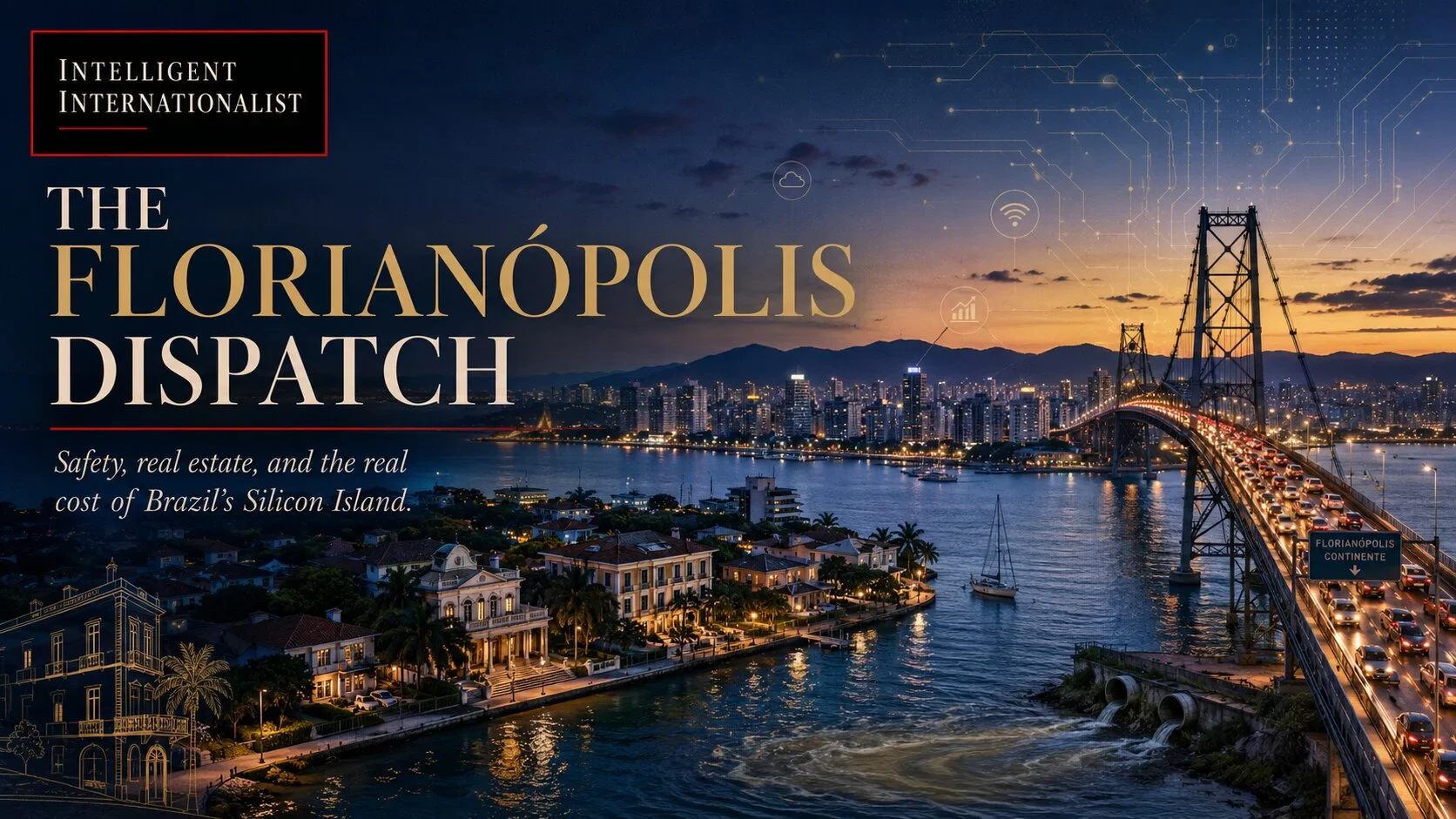
Florianópolis is Brazil's safest capital and a genuine tech hub, but the real estate pitch omits untreated sewage, bridge gridlock, and a state government at open war with Brasília.
The “Magic Island” sells safety, European lifestyle, and Silicon Valley ambitions. But a third of properties lacked sewage connections until recently, the bridges choke on summer traffic, and the federal government is at war with the state that hosts it. Here is the real ledger.
THE SAFETY ANOMALY
Brazil’s homicide rate sits at roughly 21 per 100,000 according to 2024 data, down from a peak of 31 in 2017. São Paulo runs about 9. Rio is closer to 21. These are not typos. Brazil carries a high crime index by global standards, and anyone who tells you otherwise is marketing something.
Florianópolis is the exception that proves the rule.
The 2024 Atlas of Violence, published jointly by Brazil’s Institute for Applied Economic Research (IPEA) and the Brazilian Public Security Forum (FBSP), ranked Florianópolis as the safest state capital in the country. The city’s overall crime rate sits at 780 occurrences per 100,000 inhabitants. The national average for Brazilian cities is roughly 2,500. That is not a rounding error. That is a city operating in a different statistical universe from the rest of the country.
How does a Brazilian city of 587,000 people, connected to the mainland by just three bridges, pull this off when the rest of Brazil cannot?
Part of it is structural. Florianópolis is an island. Sixty percent of the municipality sits on Santa Catarina Island, surrounded by water on all sides. Islands are harder to enter and exit quietly. The geography itself functions as a natural checkpoint. You cannot drive into Florianópolis without crossing one of three bridges, all of which are monitored. Street crime that relies on fast escape routes does not work well when the exit bottlenecks are known and surveilled.
Part of it is historical. The city has been obsessed with security since the colonial era. The Portuguese built fortresses along the coastline in the 1700s to defend against Spanish incursions. That fortress mentality never left. Modern Florianópolis has invested heavily in surveillance infrastructure, community policing, and public-private security partnerships that most Brazilian cities cannot afford because they are still fighting basic street crime.
Part of it is economic. The state of Santa Catarina has the lowest unemployment rate in Brazil, the highest GDP per capita outside of São Paulo and the Federal District, and a formal employment rate that dwarfs the national average. Crime drops when people have jobs. This is not complicated.
But the safety is uneven. The same dataset that crowned Florianópolis the safest capital in Brazil also placed it among the most violent cities in Santa Catarina state. The paradox is real. The island has favelas. It has organized crime. Neighborhoods like Morro do Mocotó, Monte Cristo, and Morro do Céu have homicide rates that look nothing like the postcard version of Floripa. The homicide rate is not zero. It is simply low enough, relative to Brazilian capitals, to be marketed as “safe.” For an American or European buyer accustomed to actual safety, calibrate your expectations. Florianópolis is safe for Brazil. That is a meaningful qualifier.
The mayor, Topázio Neto of the center-right PSD party, was re-elected in the first round of the 2024 municipal elections with a commanding lead. He ran on security, quality of life, and continued economic growth. His administration has leaned hard into the “smart city” branding, and not without substance. In March 2026, the United Nations named Florianópolis one of the world’s 20 “Zero Waste” cities, one of only three in the Americas, alongside San Francisco and Zapopan, Mexico. The city has been running recycling programs since 1986, decades ahead of the rest of Brazil. Every mayor who visits to study the waste-management system comes away impressed. Whether the system scales beyond the island is a separate question.
THE ISLAND ECONOMY
Florianópolis is not a beach town that happens to have jobs. It is a technology hub that happens to have beaches.
The city earned the nickname “Silicon Island” honestly. UFSC, the Federal University of Santa Catarina, is one of Brazil’s top research universities. For thirty years, graduates who could not find work in São Paulo or Rio stayed on the island and started companies instead. The result is an ecosystem of hundreds of technology startups concentrated in a city of half a million people. Fintech, SaaS, health tech. The portfolio is diverse. The workforce is educated and well-paid by Brazilian standards.
This matters for real estate because it creates a dual demand market. You have tourists and second-home buyers driving the beachfront and luxury segments, and you have a permanent population of high-earning tech workers driving rental demand in the business districts. Near-zero vacancy for quality long-term rentals in tech-heavy neighborhoods is not an exaggeration. It is the data.
The real estate market reflects this split personality. At the top end, Jurerê Internacional is the island’s luxury enclave. Oceanfront mansions list for R$43 million, roughly $8.35 million USD at the July 2026 exchange rate of 5.15 reais to the dollar. Five bedrooms, six baths, private nautical access. This is not a bargain market. It is a global luxury market that happens to be denominated in reais.
For a more grounded view, imovelweb.com.br, Brazil’s largest real estate portal, shows average apartment prices in Jurerê hovering around R$2.36 million, with listings ranging from R$762,000 for a compact unit to R$8.6 million for premium ocean-view properties. That is the working range for the neighborhood where most foreign buyers land.
At the entry level, studios in Novo Campeche start around R$332,000, about $64,500 USD. A three-bedroom house in Ingleses Norte, a northern beach neighborhood, lists at R$1.2 million, roughly $233,000 USD. The median price per square meter in the city is around R$7,000 to R$8,000, with wide dispersion between neighborhoods. Cacupé and Jurerê Internacional push past R$20,000 per square meter. Rio Vermelho and Ingleses sit closer to R$7,000 to R$8,000.
The prime neighborhoods break down as follows. Jurerê Internacional is where money goes to be seen. Gated, manicured, and expensive. Lagoa da Conceição is the lifestyle play. Waterfront, walkable, heavy on restaurants and nightlife, popular with younger tech workers and surfers. Campeche is the up-and-comer. Formerly a quiet beach village, now absorbing overflow from Lagoa as prices there climb. Santo Antônio de Lisboa is the heritage play. A preserved Azorean fishing village on the western shore, quieter, more residential, favored by families and retirees who value authenticity over proximity to nightlife. Cacupé is the mainland luxury corridor. Bay views, easy bridge access, increasingly popular with buyers who want space without island traffic.
The trajectory is upward. Santa Catarina’s population is growing faster than the national average. The tech sector is expanding. Foreign interest, particularly from Argentina, Uruguay, and increasingly the United States, is not slowing down. This is not a bubble. It is a structural migration to a city that offers what most of Brazil cannot: safety, jobs, and quality of life in one package.
THE INFRASTRUCTURE CONTRADICTION
Here is the number that does not appear in the marketing materials: sewage coverage in Florianópolis stood at just 67 percent as recently as 2020, according to CASAN, the state water and sanitation company. That means roughly one in three properties was not connected to the treatment system. The gap is concentrated in the southern half of the island and in older neighborhoods where retrofitting is expensive and logistically painful.
The situation is improving. CASAN opened a new treatment station in the João Paulo neighborhood in March 2025. Governor Jorginho Mello attended the ribbon-cutting. The state company has committed to expanding coverage, and the pace has accelerated under the current administration. But the southern beaches, Armação, Pântano do Sul, Açores, still await decentralized treatment solutions that CASAN has described as awaiting environmental licensing. Progress is real. It is also slow.
The water quality issue is most acute in the summer. December through February, the island’s population can double or triple. Seasonal residents from São Paulo, Argentine tourists, and European holidaymakers pour in. The beaches that look pristine in marketing photos are swimming in water that frequently fails bacterial safety standards. Locals know which beaches to avoid. Tourists rarely do.
The traffic is a related structural problem. Three bridges connect the island to the mainland. The Hercílio Luz Bridge is the iconic one. Brazil’s longest suspension bridge, closed for years for structural repairs, reopened as a pedestrian and bicycle crossing. The Colombo Salles Bridge and the Pedro Ivo Campos Bridge carry all vehicular traffic. During rush hour, during summer, during rain, or during any combination of the three, the bridges become parking lots. Driving end to end across the island can take two hours in peak conditions. The 2026 travel guides warn explicitly: plan by time, not by kilometers.
Living on the mainland, São José, Palhoça, Biguaçu, is cheaper and avoids island premiums, but you are trading housing cost for commute time. Every morning and evening, you join the bridge queue. Some expats accept the trade. Many do not, once they have lived through one summer of it.
The city government is aware of all of this. Topázio Neto’s administration talks about infrastructure investment. But the budget of a municipality of 587,000 people, however well-run, cannot re-plumb an island and build new bridges without state and federal money. And that is where the politics gets complicated.
THE POLITICAL FRICTION
Santa Catarina is Brazil’s most anti-Lula state. This is not hyperbole. It is electoral math.
Governor Jorginho Mello belongs to the PL, the party of former president Jair Bolsonaro. The state voted overwhelmingly for Bolsonaro in 2022. The relationship between the state government in Florianópolis and the federal government in Brasília is openly hostile. In June 2026, Lula visited Santa Catarina and used the occasion to attack Governor Mello on racial quota policies, invoking language Mello’s camp called xenophobic. Mello responded by filing a formal complaint with the Prosecutor General’s Office. The quarrel made national headlines. It was not a diplomatic misunderstanding. It was a declaration of war by both sides.
The practical implication for anyone considering putting capital into Santa Catarina is this: the state is thriving despite Brasília, not because of it. Federal infrastructure spending in Santa Catarina is thin. Federal programs that pour money into the Northeast barely register here. The state’s growth is self-funded, driven by a business-friendly tax environment, a disciplined fiscal policy, and an economy that does not depend on federal transfers. This is a feature, not a bug, for investors who prefer their jurisdictions fiscally conservative. But it means the bridge problem, the sewage problem, and every other infrastructure bottleneck will be solved with state and municipal money or not at all.
What about sentiment toward Americans? Brazil as a whole is a remarkably receptive country. The people are warm, curious, and genuinely welcoming to foreigners. That holds true from the Northeast to the South. Santa Catarina stands out not because it is more receptive, but because its political alignment tilts further right, closer to the United States on trade and foreign policy, and its European-descended population creates fewer cultural friction points for American expats. English is more widely spoken here than in most other Brazilian capitals outside of São Paulo. You will be welcomed. You will also occasionally be quoted the gringo price. Bring a local. Negotiate in Portuguese. Pay what locals pay.
THE NEIGHBOR COMPARISON
Ninety minutes up the coast lies Balneário Camboriú, population 150,000, known as the “Dubai of Brazil.” The nickname is not subtle. Four of South America’s five tallest buildings are in BC. The Senna Tower, currently under construction, is set to become the tallest residential building in the world, surpassing New York’s Central Park Tower. Branded residences carry names like Lamborghini and Porsche. The real estate is the most expensive in Brazil, period. Pricier per square meter than Rio’s beachfront or São Paulo’s financial district.
BC and Florianópolis represent two versions of the Santa Catarina bet. BC is speculative, high-rise, built on leverage and foreign capital inflows. The crime rate is 66 percent higher than Florianópolis (1,292 per 100,000 versus 780). The vibe is Dubai on a Brazilian beach: flashy, vertical, transactional.
Florianópolis is the family option. Lower density, more green space, a functioning tech economy that does not depend entirely on tourism and real estate speculation. If BC is where you park money, Florianópolis is where you raise children.
The deeper cultural divide runs north-south. Southern Brazil, encompassing Santa Catarina, Rio Grande do Sul, and Paraná, was settled by waves of German and Italian immigrants in the 19th and early 20th centuries. The population is predominantly white. The architecture in towns like Blumenau and Joinville looks Central European, not Latin American. Oktoberfest in Blumenau is the second-largest in the world after Munich. The food leans toward sausage, pasta, and beer rather than feijoada and caipirinhas.
Northern and Northeastern Brazil is the Brazil of postcards and popular imagination: Afro-Brazilian culture, samba, capoeira, acarajé, the Amazon, Salvador’s colonial streets. It is culturally richer, warmer, more chaotic, and significantly more dangerous.
Neither is better. They are different countries sharing a flag. Understanding this before you invest determines whether you buy the right asset in the right place or buy a fantasy that does not match the lived reality.
THE FOREIGN BUYER’S LEDGER
Brazil has one of the most open real estate markets in Latin America for foreigners. You do not need residency to buy urban property. You need a CPF, the Brazilian individual taxpayer number, which any attorney can help you obtain. You need funds transferred through a Brazilian Central Bank-registered channel. You need a notary and a real estate registry. That is the list.
The costs at closing run roughly 4 to 7 percent of the purchase price in Florianópolis. The ITBI, the municipal property transfer tax, is 2 percent in Florianópolis, confirmed by the Prefeitura de Florianópolis as of July 2026. Notary fees run 0.5 to 1 percent. Registry fees add roughly 0.4 percent. Legal fees add 1 to 2 percent. On a R$800,000 purchase, roughly $155,000 USD, total closing costs land between R$32,000 and R$56,000, about $6,200 to $10,900 USD. Nationally, ITBI rates vary from 1.5 percent in cities like Itapema to 3 percent in places like Rio de Janeiro and Balneário Camboriú. Florianópolis sits at the lower end.
The annual property tax, IPTU, is modest by global standards: 0.3 to 1.5 percent of the municipal assessed value, which is typically well below market value. Capital gains on sale run 15 to 22.5 percent for residents, a flat 15 percent for non-residents. There is no wealth tax. There is no inheritance tax at the federal level, though states levy ITCMD at rates up to 8 percent.
The VIPER investor visa is the residency pathway. Invest R$1,000,000 in Brazilian real estate, approximately $194,000 USD at the July 2026 exchange rate, and you qualify for permanent residency. The minimum drops to R$700,000, about $136,000 USD, if you buy in the North or Northeast, which is not where you are buying. These figures are confirmed by the Brazilian Ministry of Foreign Affairs (Ministério das Relações Exteriores), published on the official consular website at gov.br. The funds must come from abroad through a registered banking channel. You cannot finance the minimum. The visa leads to permanent residency, which leads to citizenship eligibility after four years of residence. It is not a golden passport program. It is a genuine path to a second citizenship in a G20 country for a six-figure real estate investment.
The catch is that Brazil is not a low-tax jurisdiction. If you become a tax resident, your worldwide income is taxable at progressive rates up to 27.5 percent. The US-Brazil tax treaty prevents double taxation, but the compliance burden is real. Many foreign property owners structure their stays to remain non-resident for tax purposes. This is legal, common, and requires professional guidance. It is not tax advice. It is what sophisticated buyers do.
THE BOTTOM LINE
Florianópolis is the most interesting contradiction in Brazilian real estate. It is the safest capital in a country with a high crime index, connected to the mainland by bridges that turn into bottlenecks, selling itself as a paradise while a third of its properties lacked sewage connections until recently. It is governed by a competent, center-right mayor in a state that is actively at war with the federal government. It runs on a tech economy that most people outside Brazil do not know exists.
The opportunity is not that Florianópolis is undiscovered. It is well-discovered. Argentines have been buying here for decades. The opportunity is that the fundamentals, safety, jobs, education, quality of life, are better here than anywhere else in Brazil, and the political alignment of the state government ensures that the business environment will remain favorable regardless of what happens in Brasília.
Prices will continue to rise. The tech migration is structural. The infrastructure problems will take years to solve, which means the islands and neighborhoods with existing solutions will command premiums. Jurerê Internacional and Lagoa da Conceição are already priced for the future. Campeche, Rio Vermelho, and Santo Antônio de Lisboa are where the next wave of appreciation will concentrate.
The play is not to buy and flip. It is to buy, hold, and let the migration do the work.
Intelligent Internationalist